Contrast Injection Certification: A Skill That Makes You More Valuable
The Hidden Value in a Certification You Might Be Overlooking
I remember the moment I realized contrast injection certification was going to change how I approached my career. I was working in a busy nuclear medicine department, and one of our radiologists mentioned during a downtime conversation that our CT techs with injection credentials were getting called first for the highest-acuity cases. That observation stuck with me. It wasn't just about doing more—it was about being more essential.
Contrast injection certification is one of those skills that doesn't seem like a big deal until you see how it ripples through your entire value proposition as a technologist. You're not just a tech who can position patients and acquire images anymore. You're someone who can handle the complete diagnostic pipeline, manage patient safety at a higher level, and contribute to clinical efficiency in tangible ways. And trust me, employers notice.
But here's the thing: not every tech pursues this. Some are intimidated by the pharmacology component. Others assume their state doesn't allow it or think the training is prohibitively expensive. And some genuinely don't understand why they should bother when their current job feels stable. I'm writing this post specifically for the techs who fall into those camps, because I've been there with each of those doubts.
Understanding What Contrast Injection Actually Means
Let me start with basics, because there's a lot of confusion around nomenclature. When we talk about contrast injection certification, we're typically referring to the ability to administer intravenous (IV) contrast media under physician supervision during imaging procedures—primarily CT scans, but also interventional procedures and certain MRI protocols.
This isn't about being a nurse. You're not starting IVs or managing complex medication interactions. What you are doing is administering a specific contrast agent via an already-established IV line, monitoring patient response, and communicating any adverse reactions to the radiologist. It's a focused skill within your scope of practice.
The contrast agent itself—usually an iodinated compound for CT or gadolinium for MRI—helps enhance visualization of specific anatomy. A patient with a potential appendicitis might get oral and IV contrast for optimal visualization. Someone being scanned for a stroke might need rapid IV contrast injection timed precisely with their scan acquisition. The contrast is doing the heavy diagnostic lifting, and you're the technologist making it happen safely and effectively.
State Regulations: The Complicated Part
Here's where it gets murky, and this is probably why so many techs avoid the conversation. Regulations around contrast injection vary significantly by state. Some states allow radiologic technologists to administer contrast under direct supervision of a radiologist. Others require additional certification or registration. A few states are still working out their position on this entirely.
For example, California has specific regulations about tech-administered contrast, while some states in the Southeast have more restrictive frameworks. Some allow it in hospital settings but not in outpatient imaging centers. It's genuinely complicated, which means you need to look up your specific state regulations—not just assume based on what you hear from colleagues in other states.
The American Registry of Radiologic Technologists (ARRT) offers a Contrast Media Administration exam, but not all states recognize ARRT certification as sufficient on its own. Some require additional state-specific training or credentials. It's worth having a conversation with your state's radiology society or your employer's compliance department to understand what pathway makes sense for you.
What The Training Actually Involves
Most contrast injection training programs run between 20-40 hours of instruction, though this varies. You'll typically spend time on:
Pharmacology fundamentals - understanding contrast composition, osmolality, osmotic load on the body, and how different agents behave in different organs.
Patient safety and assessment - screening for contraindications like renal impairment, diabetes, hypersensitivity history, and current medications that might interact with contrast media.
Adverse reaction recognition and response - knowing the difference between mild reactions (nausea, warmth) and serious ones (anaphylaxis, acute kidney injury), and understanding your role in the response.
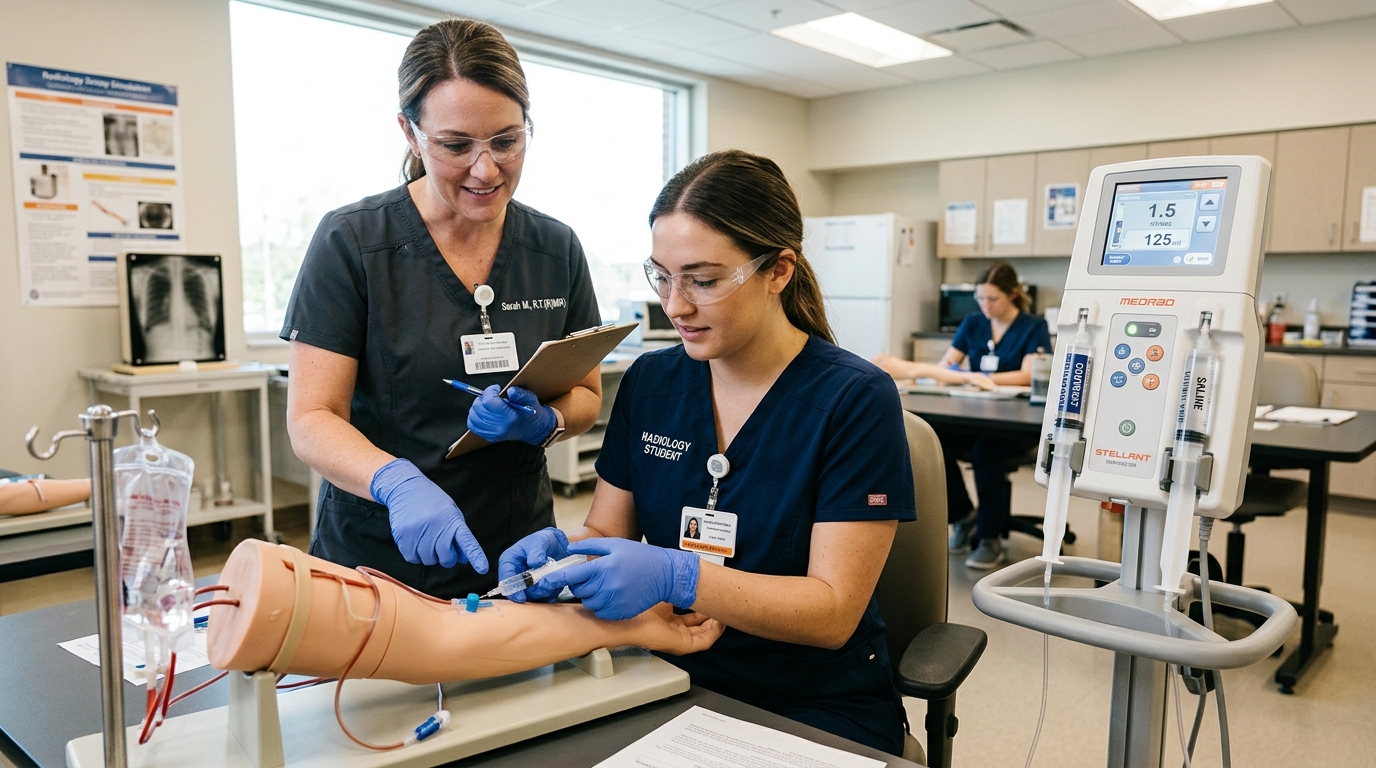
Injection technique and equipment - learning proper IV access confirmation, injection rates, power injector operation, and troubleshooting.
Legal and professional accountability - understanding scope of practice, documentation requirements, and when you need to escalate to the radiologist.
The pharmacology piece intimidated me initially. I thought I'd need to understand contrast media at the level of a pharmacist. The reality is more practical—you need enough knowledge to understand why certain patients shouldn't get certain agents and what signs suggest a problem. Most programs make this accessible even if chemistry wasn't your strength in college.
The Resistance Is Real (And Worth Examining)
I've talked to plenty of techs who've said, "Why would I want to do more for the same pay?" It's a fair question. But here's what I've seen play out:
First, this certification often does translate to financial compensation. Some employers offer modest salary increases. More commonly, you become eligible for premium shifts, complex case work, and interventional procedures that pay differently. You might not see a dramatic raise, but you're not working harder for free.
Second—and this is the less-discussed benefit—it makes you genuinely irreplaceable during staffing crunches. When your department is short-handed and everyone's scrambling, you're not just filling a role. You're the person who can handle the full scope of work, and that matters for your job security and flexibility.
Third, it expands your career options. Want to move to a different hospital or imaging center? Having contrast injection certification opens doors that might otherwise be closed. Want to move into interventional radiology? It's almost expected. Want leadership opportunities? Demonstrating this level of clinical expertise is a signal to administration that you're serious about your profession.
But I also want to acknowledge the valid concern: what if I don't want to give more? That's legitimate. If you're content in your current role and your employer isn't pushing it or offering incentive, there's no shame in that choice. This isn't a certification everyone needs. It's a certification for techs who want to expand their professional identity and market value.
The Workflow Reality
Let me paint a realistic picture of how this actually changes your day.
Before contrast injection certification, you might prepare the patient, position them, start the scan, and hand off to the radiologist who might request another series or question your positioning. You're executing the imaging order as written.
With certification, you're integrated differently. You're assessing the patient upfront—asking about kidney function, allergies, recent medications. You're positioning them knowing that you'll likely be injecting contrast and watching their response. You're timing your injection with the radiologist's acquisition protocol. You're watching the monitor during the injection, ready to notice if something seems off. You're documenting the contrast administration, any reactions, and clinical observations.
It sounds like more work, but honestly? It makes the imaging better. And when the imaging is better, the diagnosis is clearer, and the patient gets better care. There's something professionally satisfying about that integration.
Making The Decision For Your Career
Here's how I'd think about this if I were in your shoes right now:
Step one: Look up your state's specific regulations. Get clear on what's actually allowed where you work. This isn't optional—you can't evaluate the option without knowing the rules.
Step two: Talk to techs at your facility who have this certification. Ask them how it changed their work, whether they felt the training was worthwhile, and what they wish they'd known beforehand.
Step three: Ask your manager or supervisor whether your employer values this credential and what incentives exist. You might be surprised by the answer. Some employers actively encourage it; others are neutral.
Step four: Honestly assess whether you want to expand your scope of practice. If the answer is yes, you've got your direction. If the answer is no, that's fine too—this isn't a universal requirement.
The Bigger Picture
What I've learned through my years in nuclear medicine and working with colleagues in CT and other modalities is that the radiology profession is continuously evolving. The techs who thrive are the ones who see these skill expansions not as burdens but as invitations to grow.
Contrast injection certification is a marker. It says you're willing to deepen your clinical knowledge. It says you're invested in patient safety at a higher level. It says you see yourself as more than someone who presses buttons—you see yourself as an integral part of the diagnostic team.
That's valuable. Employers know it. Patients benefit from it. And frankly, your career benefits from it too.
If you're even slightly curious, I'd encourage you to pursue it. The training is manageable, the credential is increasingly recognized, and the impact on your career trajectory is real. You might surprise yourself with how much you enjoy the deeper clinical engagement that comes with it.
Related Articles

Burned Out as a Rad Tech? Here's How to Reignite Your Career
April 23, 2026

Managing Up: How Rad Techs Can Influence Department Decisions
April 22, 2026

How to Compete With Travel Agency Pay Without Breaking Your Budget
April 22, 2026
Quality Assurance in Radiology: Why QA Culture Affects Retention
April 21, 2026