Pediatric Radiology: A Specialty That Needs More Champions
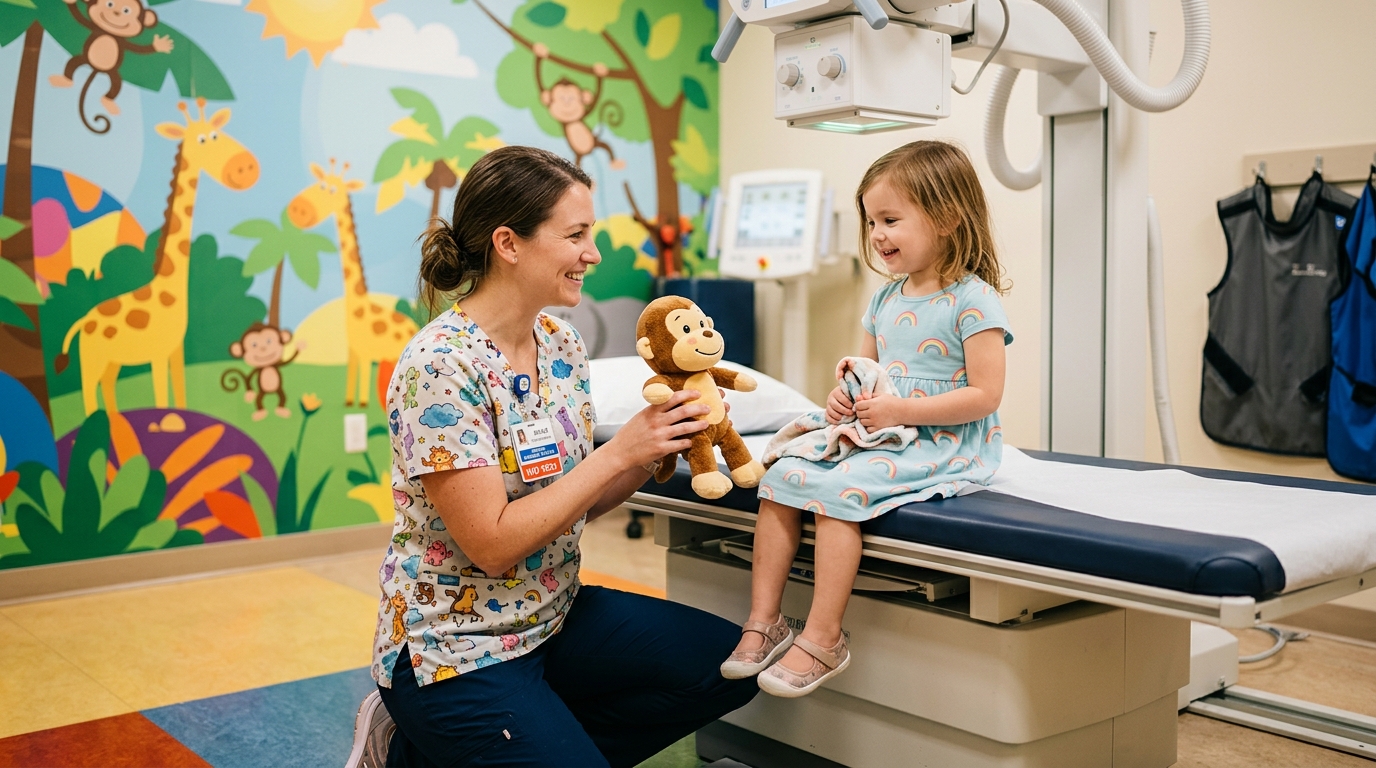
I still remember the first time I worked a pediatric MRI rotation. I was cocky. I'd been an MRI tech for five years in an adult hospital. I had the protocols down. I knew equipment inside and out. I figured pediatric imaging would just be a scaled-down version of what I already knew.
I was completely wrong.
The first patient was an eight-year-old girl who needed an abdominal MRI to rule out appendicitis. She was terrified. Parents were terrified. She'd already had a bad experience with CT—held down, traumatized, the whole thing. She was convinced the MRI machine was going to hurt her.
I spent forty-five minutes talking to her. We looked at pictures on the computer. I let her hear the machine sounds with headphones. We pretended the machine was a spaceship and she was an astronaut, and we needed to take pictures to check the spaceship's systems. Her parents sat beside her. By the time she actually went in, she was calm. She got beautiful images. No sedation needed.
That rotation changed what I wanted out of my career.
Pediatric radiology is the most undervalued specialty in medical imaging. And if you haven't really considered it, I want to tell you why it should be on your radar—and why departments desperately need more skilled technologists willing to do this work.
Why Pediatric Imaging Is Different (And Harder)
Here's the thing: pediatric radiology isn't just about scaling down adult protocols. It's about reimagining the entire experience.
With adults, you explain the procedure, they comply, you get your images. It's a transaction. With kids, you're managing fear, developmental stages, cooperation, parental anxiety, and the fundamental challenge that a frightened five-year-old cannot hold still on command.
The physics and safety considerations are different too. Pediatric patients require different radiation doses for CT. Contrast protocols are different. Anatomy is different—literally. A child's organs are in different positions and have different proportions than an adult's. And you're often working with less-specific symptom pictures. Parents bring in kids with "abdominal pain" and you need to figure out if it's appendicitis, intussusception, gastroenteritis, or something else entirely.
The stakes feel different. When you're imaging an adult, there's sympathy. When you're imaging a kid, there's something else—a sense that you're part of helping their family get answers in what might be the scariest moment they've had.
Add to that the variability. Adult patients mostly come in able to communicate and cooperate (with exceptions). Kids come in across a developmental spectrum. A three-year-old can't follow instructions. A seven-year-old can, but might not. A fifteen-year-old can, but might be too anxious. You need different strategies for all of them.
And here's what most departments don't talk about: pediatric imaging has the highest variability in image quality because of patient cooperation. Which means the technical skill required is actually higher. You need to know how to position a frightened three-year-old to get diagnostic images without sedation. You need to anticipate motion and compensate for it. You need to know when sedation is necessary versus when you just need a better approach.
The Shortage Nobody's Talking About
Here's a stat that should wake up imaging leadership: pediatric radiology departments nationwide are struggling harder to staff their units than adult departments. While the general rad tech shortage is real, the pediatric shortage is acute.
Why? Because most radiology technologists aren't trained in pediatric-specific techniques during their initial education. It's not really covered in most RT programs. You learn adult protocols, you take your certification, and then if you work pediatrics, you're learning on the job. That's a real disadvantage when you're trying to build expertise.
Plus, honestly, a lot of technologists actively avoid pediatrics. They think it's going to be exhausting or depressing. They've heard stories about difficult families or uncooperative kids. They wonder if they'll actually be good at it.
And then there's the elephant in the room: pediatric imaging doesn't pay more. In fact, depending on your facility, it might pay slightly less because there's less volume and less complex pathology. That doesn't make sense. It's harder work. It requires more skill and more emotional labor. But that's the reality.
This creates a staffing crisis in pediatric departments. And it means that kids—and families—often get imaged by people who either aren't trained in pediatric technique or actively don't want to be there.
That's not okay.
What Makes Someone Great at Pediatric Imaging
I've worked with techs in pediatrics for the last few years through my coaching practice, and there are consistent traits in the ones who thrive.
Genuine patience. This isn't "tolerance for delay." This is actual patience—the kind where you're not internally frustrated when a four-year-old takes eight minutes to settle into position. It's curiosity about what the kid actually needs, not judgment about them not cooperating.
Flexibility and creativity. Adult imaging is protocol-driven. You follow the protocol. Pediatric imaging requires you to modify the protocol on the fly. Maybe the patient is too anxious for a standard scan, so you need a different approach. Maybe positioning is impossible the normal way, so you improvise. The best pediatric techs are problem-solvers first, protocol-followers second.
Actual communication skills. Not just explaining things. Actually connecting with kids at their level. Using language they understand. Being honest with them (kids know when you're lying). Treating them like people, not moving obstacles.
I worked with one techs who would name each MRI machine—"This is Sally the scanner"—and talk about Sally's preferences and quirks. Sounds silly. It worked. Kids engaged with Sally instead of being afraid of the big scary machine.
Comfort with families. Adults come alone or with a partner. Kids come with parents or guardians who are often at high anxiety levels themselves. You're managing the patient and the family system. Some techs hate that. Some techs are energized by it. The ones who thrive in pediatrics usually love working with families.
Emotional resilience. You're going to see sick kids. You're going to imaging children with cancer, congenital conditions, traumatic injuries. You carry some of that. You have to be able to do your job, care deeply, and then leave it at work. It's an emotional skill that not everyone has, and that's okay. But if you're considering pediatric imaging, you need to be honest with yourself about whether you can do it.
The Actual Rewards (Beyond the Salary You're Not Getting)
This is where I want to get real about why pediatric imaging is worth it despite the challenges.
You prevent harm. In adult imaging, you're usually confirming or ruling out what the doctor suspected. In pediatrics, you're frequently preventing unnecessary interventions. A good ultrasound can rule out appendicitis and keep a kid out of surgery. That matters. That's a kid who goes home to their family without a surgical scar.
You build trust that carries through medicine. Every interaction a kid has with medical professionals shapes how they approach healthcare for the rest of their lives. If their first imaging experience is traumatic, they're building anxiety patterns. If it's calm and respectful, they're building resilience and trust. You're literally shaping how that kid approaches healthcare for decades.
You're part of the most important clinical moments. When a family is scared about their kid, getting answers through imaging is huge. I've imaged kids the morning of life-changing diagnoses. I've also imaged kids where imaging rules out the scary thing and families go home relieved. Either way, you're at the center of a pivotal moment. That's not a small thing.
The relationships are different. In adult imaging, you're a technician. In pediatric imaging, you're often a source of comfort. Parents remember you. Kids remember you. I've had families request me for follow-up imaging months later. I've had kids give me drawings they made at home. That human connection is real, and it's something a lot of technologists chase but don't find in adult imaging.
The expertise is genuinely respected. Good pediatric technologists are hard to find. Pediatricians and pediatric radiologists know this. If you develop real expertise in pediatric imaging—advanced techniques, specialized knowledge in pediatric ultrasound or pediatric MRI—you become invaluable. That translates to job security, flexibility, and professional standing.
What You Need to Know Before You Switch
Okay, I'm not going to sugarcoat the challenges.
It's more demanding physically. You're often positioning kids who can't stay still. You're lifting, maneuvering, adjusting. It's more demanding mentally. You're problem-solving constantly. You're managing anxiety. You're thinking about how to accomplish a diagnostic goal with an uncooperative or frightened patient.
The hours can be rough. Pediatric emergencies don't happen on a schedule. You might have a slow morning and then three traumas in a row. Pediatric imaging often requires more time per patient than adult imaging, so you might scan fewer people but work harder.
And the emotional weight is real. You're going to see suffering. You're going to struggle with cases. You're going to think about patients afterward in ways adult imaging doesn't usually trigger.
But here's what I want you to know: if you're someone who got into radiology because you wanted to help people, pediatric imaging is the specialty where that actually feels true. It's where the work matters in a way that's viscerally clear. It's not abstract. It's a kid and their family and your ability to get them an answer.
If You're Interested: How to Get Started
Most pediatric departments will hire experienced radiologic technologists and train them. You don't need a pediatric specialty certification to start. You need willingness to learn and real commitment to getting good at pediatric technique.
Some hospitals have formal pediatric imaging tracks. Others are happy to train people on the job. The best approach is being honest: talk to pediatric departments about what they're looking for. Ask about training. Ask about mentorship.
If you're still in school or early in your career, seek out pediatric rotations. Get comfortable with pediatric protocols. Build relationships with pediatric techs. That experience matters.
And if you're established in adult imaging but feeling burned out or uninspired, consider a transition. Some of the best pediatric techs I know came from adult imaging because they were hungry for something more meaningful.
Pediatric radiology needs champions. It needs experienced, skilled technologists who care about getting kids good images and families good answers. It needs people who see a frightened child as a problem to solve creatively, not an obstacle to work around.
If that's you, your department is waiting. And trust me: this specialty will change your entire relationship with why you became a technologist in the first place.
Related Articles

Burned Out as a Rad Tech? Here's How to Reignite Your Career
April 23, 2026

How to Compete With Travel Agency Pay Without Breaking Your Budget
April 22, 2026

Managing Up: How Rad Techs Can Influence Department Decisions
April 22, 2026

Travel Rad Tech Life: The Honest Pros and Cons Nobody Tells You
April 21, 2026