DEXA Scan Technologist: A Niche Certification With Growing Demand
Nobody talks about DEXA scanning.
Seriously. In all the radiology tech education circles I participate in, all the conferences I attend, all the career planning sessions I facilitate, DEXA comes up maybe five percent as often as CT, MRI, or sonography. And that's a massive oversight.
I made the decision to add DEXA certification about eight years ago, not because it was my passion but because I had a patient. She was 72, had osteoporosis, had fallen, and I was helping her position for follow-up imaging. She mentioned she'd never had a bone density scan but her doctor recommended one. When I asked why she hadn't gotten it, she said the nearest facility was an hour away and she'd just keep getting lucky.
That conversation haunted me. Here was someone who could have had early intervention for a bone health issue that was literally never screened because access and awareness are terrible for DEXA. I decided right then I was going to learn this modality.
Now, eight years later, I think it's one of the best professional decisions I made. Not for fame or money—DEXA isn't flashy. But for impact, accessibility, and career sustainability, it's genuinely underrated. And in 2026, with the baby boomer population aging and bone health becoming increasingly important, the demand is finally catching up to the need.
What DEXA Actually Is (And Why It Matters More Than You Think)
DEXA stands for Dual-Energy X-ray Absorptiometry. It measures bone mineral density to assess fracture risk and osteoporosis status. Sounds boring. Is functionally one of the most preventive screenings in radiology.
Here's why it matters: osteoporotic fractures are devastating in older populations. A hip fracture at 75 often means loss of independence, complications, and sometimes mortality. But osteoporosis develops silently. A patient can have severe bone loss and feel completely fine until they fall. DEXA catches this before the fall happens.
I work with a lot of primary care physicians, and the moment they learned we were offering DEXA, referrals jumped. Not because they didn't know the screening existed—they did. But because most patients don't have easy access, many insurance plans require specific facilities, and awareness is low. When you have a convenient DEXA service with someone who knows how to scan and can communicate results effectively, physicians use it.
The science is solid. DEXA is the gold standard screening tool for bone density assessment. Radiation exposure is minimal—about 1/10th the dose of a standard chest X-ray, and way less than CT. The scan is quick, painless, and non-invasive. From a patient experience standpoint, it's about as pleasant as a medical test gets.
And yet, most radiology techs have maybe one DEXA unit they can access, often staffed minimally, rarely at capacity.
The Certification Path: It's Actually Accessible
Here's the good news compared to advanced certifications like CT or MRI: DEXA certification is achievable relatively quickly and doesn't require as much prerequisite training.
Most facilities require you to be a registered radiologic technologist (ARRT) first. That's standard. Then you need DEXA-specific training, which can come from manufacturer certifications (GE, Hologic, Lunar) or from formal DEXA programs through imaging centers.
The typical pathway is: 40-80 hours of didactic training plus 40-80 hours of clinical practice under supervision. So roughly 3-4 months of focused study, depending on your facility's requirements and your own pace. Some facilities are more structured and offer formal DEXA certification programs. Others have you learn from current staff and take certification exams independently.
The ARRT offers the DEXA examination (the credential is typically listed as ARRT-DEXA or credentialed in DEXA), which is significantly easier to study for than CT or MRI exams. We're talking maybe 50-100 practice questions to master the core concepts, not the 2,000+ required for advanced certifications.
This is huge because it means a newer technologist or someone looking to add a credential without investing six months of intense study can do this. I know techs who've gotten DEXA certified while maintaining PRN shifts, something that would be impossible with MRI or advanced CT protocols.
Cost-wise, your facility often covers it if they're offering DEXA services. If not, DEXA certification courses are usually $2,000-4,000 total, significantly less than MRI or CT programs. Some online courses are even cheaper, though clinical hours are harder to come by that way.
What The Work Is Actually Like
This is the part nobody discusses, so let me be concrete.
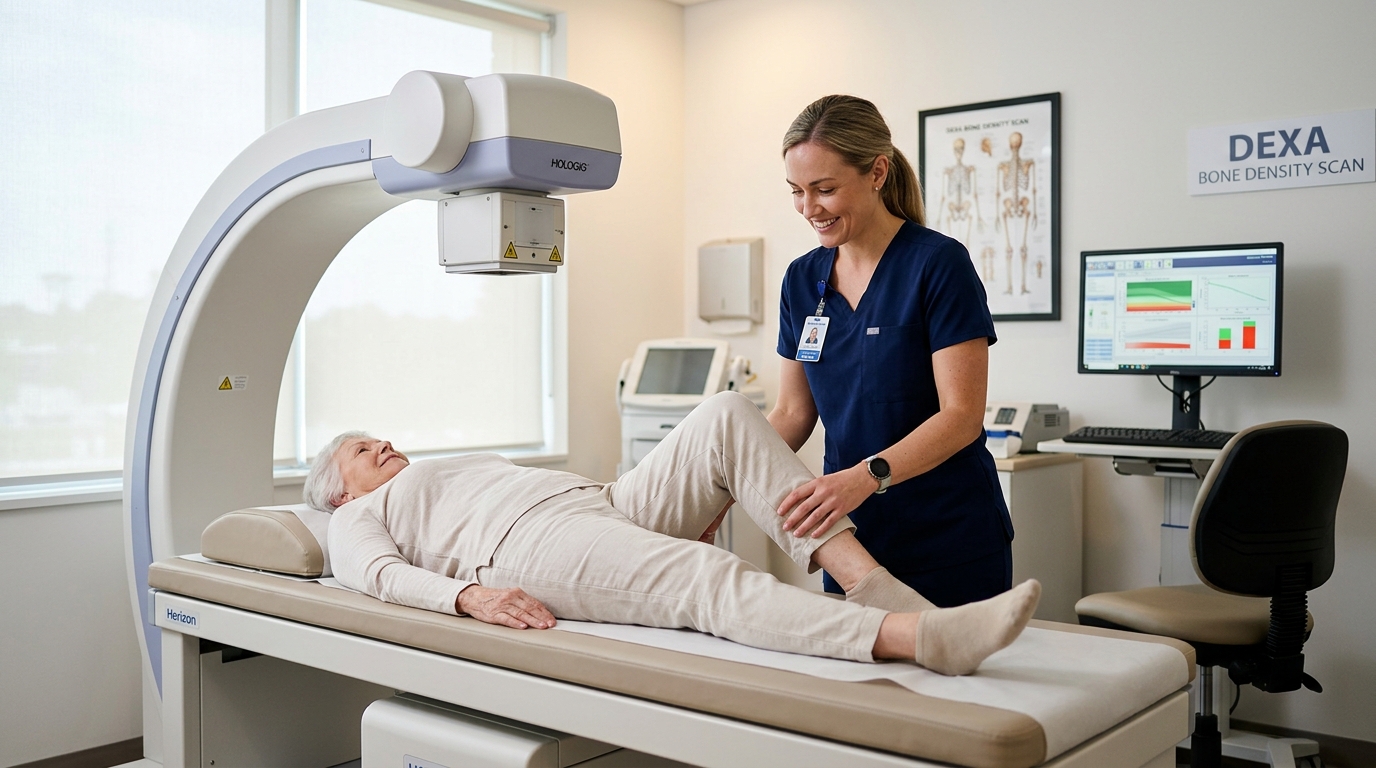
A typical DEXA appointment is 30 minutes. Patient comes in, checks in, you explain the scan (which involves basically zero radiation anxiety compared to other modalities—it's genuinely safe). They lie on the scanning bed in comfortable clothing. You position them, take the scan, which takes maybe 10-15 minutes per site (hip, spine, and sometimes forearm depending on physician orders). They get dressed, maybe you do a quick education bit about results and follow-up, and they're done.
The patient population is almost exclusively outpatient and older. Mostly women, though increasingly men are being screened (osteoporosis in men is underdiagnosed and undertreated). They tend to be calm, grateful for the preventive care, and often quite chatty. I've had more meaningful conversations with DEXA patients than I had in my first two years of CT scanning.
The work is low-stress physically. You're not transferring patients. You're not running codes. You're not dealing with trauma or acutely ill patients. It's methodical, quiet, and genuinely peaceful. After 10 years of fast-paced nuclear medicine, I find DEXA scanning restorative.
The physician interaction is different too. DEXA results are mostly straightforward—normal, osteopenia, osteoporosis—but physicians use them to make actual clinical decisions. I'll send notes about positioning or image quality and physicians often respond with management plans. There's closure to the work that's really satisfying.
Staffing is usually minimal, which is both a pro and a con. You might be a single technologist covering DEXA clinics, which means you run your own schedule somewhat, but you also don't have backup if something goes wrong with equipment or if you need support. Facilities vary wildly on this.
The Salary Reality
DEXA doesn't pay more than other modalities. This is important to be clear about. You won't make extra money primarily doing DEXA.
However. Most techs don't do DEXA exclusively. It's an add-on credential. You work DEXA clinics three days a week, maybe, and maintain other modalities. This creates flexibility that actually matters financially.
I work two DEXA clinics per week (about 10 hours), and the rest of my time I'm available for nuclear medicine or helping with mobile imaging. This mix lets me avoid burnout better than a full-time CT tech who's doing 200 scans per week. The variety is worth something financially because it reduces the burnout and turnover that otherwise happen.
Facilities offering DEXA services sometimes offer shift differentials for early morning clinics (many bone health programs are in the morning for older patients). A few facilities I know of offer small bonuses if techs have DEXA certification to keep coverage flexible.
Salary expectations: you're not adding $10,000 to your annual income by getting DEXA certified. You might add $3,000-5,000 if you're working regular DEXA clinics and maybe getting overtime from coverage. But you gain scheduling flexibility, lower burnout risk, and exposure to preventive medicine that most techs don't get. That's worth more than the numerical difference.
Who This Is Actually Right For
I'm going to be honest about who benefits most from DEXA certification:
Best fit: Established techs with 3+ years of experience in a primary modality who want to reduce burnout and add variety. You've got the basics down and you're ready for something methodical and lower-stress.
Good fit: Newer techs who are burned out by high-volume scanning and want to try something with better pacing. DEXA can save your career if you're on the edge of leaving imaging entirely because you hate the volume-based model.
Okay fit: Anyone looking for a relatively easy credential to add to their resume if they don't have advanced certifications yet. Getting DEXA certified before CT or MRI is smarter than I see happen often.
Avoid if: You're the type who needs constant high-acuity stimulation. If you get bored easily or love the fast pace of trauma and critical care, DEXA is going to feel glacially slow. That's fine—different people thrive in different environments.
Avoid if: Your facility has no plans to expand DEXA services and you're just adding a credential no one will use. Credentials are only valuable if you can actually practice them.
The Demand Is Actually Growing
Here's the thing that made me write this article: bone density screening rates are finally climbing.
Medicare introduced specific coverage criteria for bone density screening in women over 65 and men over 70 in 2008. Actual utilization is now increasing because awareness is improving. More primary care offices are ordering screening. More facilities are opening bone health programs.
At the same time, DEXA technologist supply hasn't caught up. Most imaging centers have minimal DEXA staff. Many don't offer it at all despite having interested patients and referring physicians. If you work in an area where DEXA services are undersupplied, you've immediately become more valuable by having this certification.
I've had three people in my network get jobs primarily because they were willing to develop DEXA services at their facility. The facility didn't have in-house DEXA capability, they kept losing referrals, and then they found someone with DEXA certification who was willing to build a program. That person got a better schedule, flexibility, and administrative support in exchange.
The radiology tech shortage is real across all modalities, but DEXA is the weird niche where demand is growing while supply is stagnant. That's an opportunity.
The Real Value: Sustainability
Here's what I want you to understand about DEXA certification that goes beyond the economics: it's a tool for career sustainability.
I have colleagues who've worked high-volume CT or ultrasound for 20 years and are now dealing with repetitive stress injuries. I know MRI techs who are burned out from the physical demands of patient transfer and troubleshooting at 3 AM. I know mobile techs who've spent years traveling and are exhausted.
Adding or transitioning to a DEXA practice doesn't solve everything, but it gives you options. It's lower physical demand. It's lower mental demand. It's stable and predictable. For a technologist with a decade of experience who's starting to feel the wear, it's a legitimate pivot to extend your career.
Some people work DEXA specifically because they're semi-retiring and want part-time, low-stress work. Some people maintain it as a specialization so they can reduce hours if needed. Some people use it as a springboard into education or administration because bone health programs often need people who understand both the clinical and administrative sides.
My advice: if you've been in radiology more than three years and you're starting to think about variety or sustainability, look into DEXA. It might not be flashy, but it might be exactly what your career needs.
Related Articles

Burned Out as a Rad Tech? Here's How to Reignite Your Career
April 23, 2026
Managing Up: How Rad Techs Can Influence Department Decisions
April 22, 2026

How to Compete With Travel Agency Pay Without Breaking Your Budget
April 22, 2026
Quality Assurance in Radiology: Why QA Culture Affects Retention
April 21, 2026