Teleradiology and the Rad Tech: How Remote Reading Affects Your Job
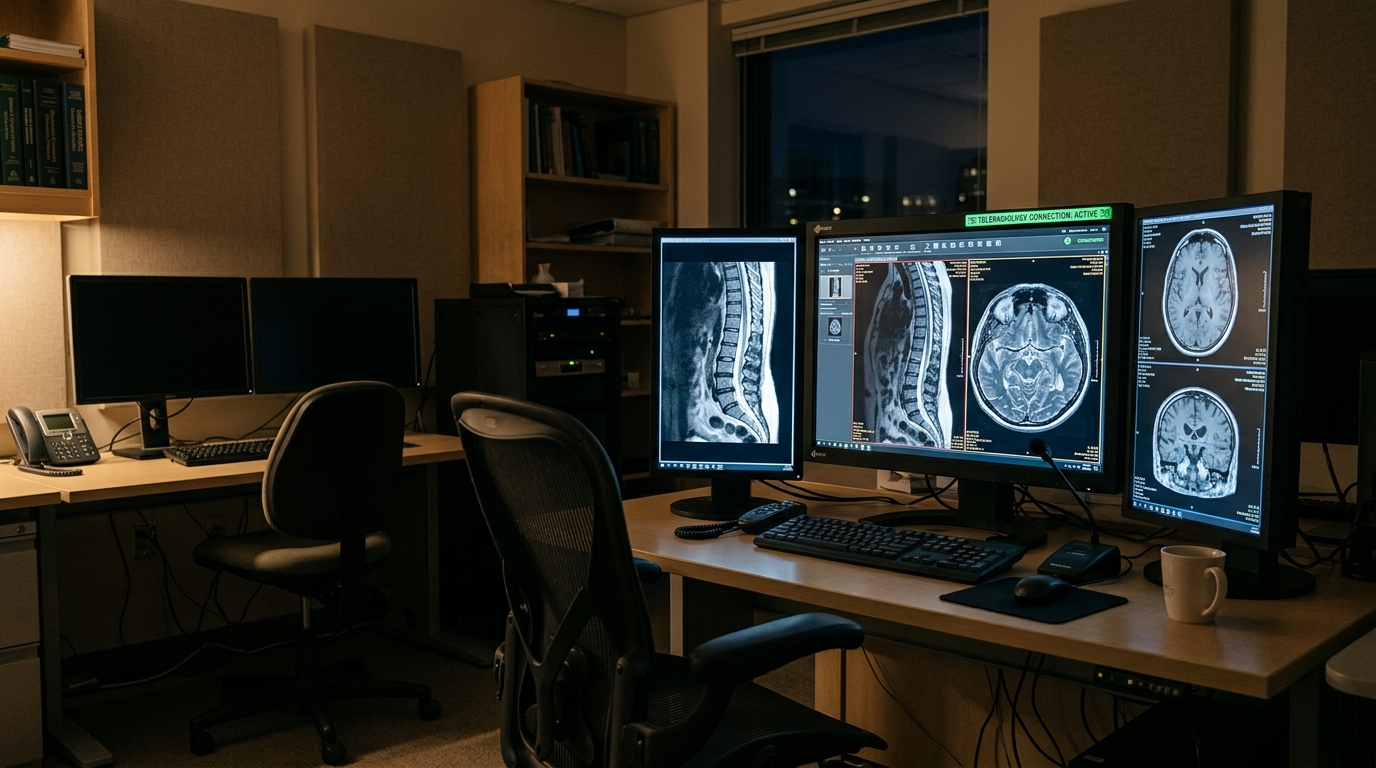
Let me start with what I think is a misconception: a lot of rad techs hear "teleradiology" and think it means their job is going remote, or getting eliminated, or somehow becoming less relevant. That's not what's happening. Teleradiology is a big shift in how radiologists work, and it affects our workflows, our nights, and our communication patterns—but rad techs aren't going anywhere. In fact, understanding teleradiology is increasingly important to your career.
I've been a rad tech for fifteen years, and I've worked in traditional departments with radiologists on-site and in facilities that transitioned to teleradiology. I've seen the good parts and the frustrating parts. I've watched what stayed the same and what fundamentally changed. Let me walk you through the real impact.
What Teleradiology Actually Is (And Isn't)
First, clarity: teleradiology means radiologists read imaging studies remotely, often from locations outside the hospital where the images were acquired. They're not in the building. They're looking at PACS (Picture Archiving and Communication System) images on a remote computer, and they're sending reports back digitally.
What it does NOT mean: it doesn't mean automation. It doesn't mean AI is reading your images (not primarily anyway—AI is a different conversation). It doesn't mean the radiologist role is shrinking. It means the radiologist's location has changed.
For us as rad techs, this is important because our entire job is fundamentally relational to the radiologist. We acquire the images. They interpret them. Teleradiology changes the nature of that relationship from in-person to digital.
Some facilities use teleradiology as a primary model: all radiologists read remotely all the time. Others use it secondarily: radiologists on-site read most studies, but after-hours studies get read by teleradiology groups. Other facilities use it for specific purposes like nighttime coverage, subspecialty consultation, or overflow volume.
The model varies. The impact on you depends on which model your facility uses.
The Workflow Changes You'll Actually Notice
Here's what changes when your facility goes teleradiology or integrates it into operations:
Image quality becomes non-negotiable. This is the biggest one. When a radiologist is in the hospital, they can call you back if an image is borderline. "Hey John, can we get another view? I need to see the thing better." With teleradiology, you have one shot to get the image right. If it's suboptimal, the radiologist can't ask you to redo it in real-time—they're reading it hours or days later from somewhere else.
This means protocols become more important. Standard positioning becomes more critical. Quality control becomes something you're thinking about constantly. You can't be sloppy about positioning because the person interpreting the image can't course-correct with you in real-time.
That's actually not bad, by the way. I've noticed techs in teleradiology environments tend to be more technically precise. There's no safety net, so you become more careful.
Communication changes from verbal to digital. In a traditional department, if something doesn't look right on an image, you might grab the radiologist and say, "Hey, what do you think of this artifact?" In teleradiology, you're leaving a note in PACS or sending an email. That message gets read later, maybe much later.
I noticed this really affects how we handle urgent or concerning findings. In a traditional setup, if you see something that looks really off—bad artifact, positioning issue, patient positioning problem—you can talk to the radiologist immediately. They can guide you. In teleradiology, you're more on your own to decide whether something needs immediate attention or can wait for the remote reader.
Good facilities address this by having protocols for "critical communication." You know what warrants a phone call to the radiologist and what can be a message. That clarity helps.
Night shift work intensifies. Here's where teleradiology gets interesting for night shift techs. In a traditional hospital with on-site radiologists, night shift radiologists are physically present. You might see them. You might hand off a study to them. There's a presence.
In teleradiology, night shift studies are often sent to a teleradiology group—sometimes in another state, sometimes on another continent if it's international teleradiology. You acquire the images, you send them into the system, and hours later (or sometimes in real-time depending on the service level), a remote radiologist you've never met reads them.
This can feel isolating. But it also means night shift becomes less staffing-intensive from a radiology perspective. Some facilities use this to justify better night shift bonuses because the teleradiology service is carrying the after-hours burden.
Subspecialty access improves dramatically. This is actually a huge advantage. In a traditional setup, if you need a specialist to review an image—a neuroradiologist for brain imaging, an abdominal imager for a complex CT, a breast specialist for mammography—you're limited to whoever happens to be in your hospital. In teleradiology, your facility can subscribe to subspecialty reads from experts anywhere. You might get the best breast radiologist in the country reviewing your mammogram instead of whoever's on call.
For us as techs, this means our images are being reviewed by specialists who might catch things a generalist wouldn't. That's good for patients and good for our professional standards.
The Staffing and Job Security Questions
A lot of techs worry that teleradiology means fewer radiologists needed, which somehow translates to fewer techs needed. That's not how it actually works.
Teleradiology doesn't eliminate radiologist positions. It redistributes them. Instead of having radiologists in every hospital, you have consolidated reading centers with radiologists covering multiple facilities. From an efficiency standpoint, this works—one radiologist can read more studies because they're not interrupted by in-person clinical demands.
For rad techs, the impact is minimal because imaging volume hasn't decreased. You still need someone to acquire the images. That's still you. The radiologist's location doesn't change your job in that fundamental way.
What does change: your career path options. In a traditional setup, you might aspire to become a lead tech working under the supervision of on-site radiologists. In a teleradiology environment, lead tech roles exist but the supervision structure is different. That might limit or expand opportunities depending on your facility.
Also, some facilities have used teleradiology as an excuse to consolidate positions, and that's frustrating. But that's a management decision, not a teleradiology requirement. The technology itself doesn't eliminate rad tech jobs.
The Communication Challenge
Here's what I think is the real challenge with teleradiology, and it's human, not technical: the relationship between rad techs and radiologists becomes more transactional.
In a traditional setting, you develop relationships with radiologists. You understand their preferences. They understand your strengths and challenges. There's institutional knowledge. There's professional relationship.
In teleradiology, you're one of hundreds of techs sending images to a remote reader who's reading images from dozens of facilities. There's no relationship-building. It's clinical but impersonal.
I won't pretend this isn't a loss. I miss the days when the radiologist knew my name and I knew their reading preferences. But I've also accepted that this is the direction healthcare is moving, and there are efficiencies that matter.
What helps: facilities that have invested in good communication infrastructure. A facility where you can easily reach teleradiology readers if you have questions, where there's clarity about protocols, where your feedback is actually heard—that reduces the alienation.
I worked at a place where the teleradiology service sent regular clinical updates to the tech department. "Here's what we're seeing in your studies. Here are positioning issues we've noticed. Here's what's improving." That kind of feedback loop makes the remote relationship feel less distant.
Night Shift Considerations
Night shift becomes a different animal in teleradiology environments. On one hand, you're not waiting around for an on-site radiologist to read your studies. You acquire, you send, you move on. That's actually liberating.
On the other hand, if something urgent happens—a patient codes, a clinical team needs a stat reading—the process becomes more bureaucratic. You're calling a teleradiology service instead of running upstairs to grab the radiologist.
Some facilities are smart about this. They keep on-site radiologists for certain hours and use teleradiology overflow. That's the best model, honestly. You get the efficiency of teleradiology without losing the responsiveness of on-site coverage.
If you're considering a night shift position in a teleradiology environment, ask specifically about stat procedure protocols. How are emergencies handled? What's the callback process? How long until a stat study is read? These aren't simple questions, but the answers matter for your work experience.
The Part That Hasn't Changed
Here's what I want to emphasize because I think it gets lost in all this discussion: the core of rad tech work remains the same.
You're still acquiring high-quality images of patients. You're still applying positioning knowledge, protocol knowledge, and anatomy knowledge. You're still managing patient safety and privacy. You're still communicating with clinical teams. You're still the person ensuring that the radiologist has the information they need to make a diagnosis.
Teleradiology changes how radiologists work. It doesn't change what you do.
Some days, I notice the difference. I wish I could talk to the radiologist about a finding. I wish there was someone in the building I could grab for a quick consultation. But mostly, I just do my job: position the patient, acquire the image, ensure quality, send it to PACS, and move to the next patient.
The remote radiologist reads it and produces a report. The patient gets clinical care. It works.
What This Means for Your Career
If you're developing a career in radiology, understanding teleradiology is important. It's not going away—it's expanding. Facilities are integrating it more deeply every year.
Here's what I'd recommend: if you're early in your career, find a facility where you can experience both traditional and teleradiology workflows. Understand both models. Understand how you work in each. Understand what you prefer.
Some techs love teleradiology because it's more independent. You're not answering to someone in the building. You've got autonomy. Other techs hate it because they miss the collaboration and feedback. Both reactions are legitimate.
Also consider specialization. Teleradiology impacts some modalities more than others. CT and general radiography adapted quickly. Ultrasound is trickier because real-time feedback matters more. Interventional radiography requires on-site presence. Knowing how your specialty intersects with teleradiology helps you navigate your career.
The Human Element Persists
I've been a rad tech for fifteen years. I've worked in hospitals built around radiologist presence and in facilities where radiologists are purely remote. The technology is different. The workflows are different. The economics are different.
But the actual work—the human skill of acquiring a quality image, communicating clearly, understanding anatomy, ensuring patient safety—that hasn't changed. That's still the core of what we do.
Teleradiology is a tool. Like any tool, it changes how we work but doesn't eliminate the fundamentals of the work itself. Understanding that distinction helps you navigate the industry shift without feeling threatened by it.
The future of radiology involves more teleradiology. That's clear. But it also still involves rad techs doing exactly what we do now: translating medical orders and patient anatomy into high-quality diagnostic images.
That job isn't going away. The location of the people reading those images is just shifting.
Related Articles
Burned Out as a Rad Tech? Here's How to Reignite Your Career
April 23, 2026
Managing Up: How Rad Techs Can Influence Department Decisions
April 22, 2026
How to Compete With Travel Agency Pay Without Breaking Your Budget
April 22, 2026
Quality Assurance in Radiology: Why QA Culture Affects Retention
April 21, 2026