Rad Tech Professional Development Plans: A Template for Every Career Stage
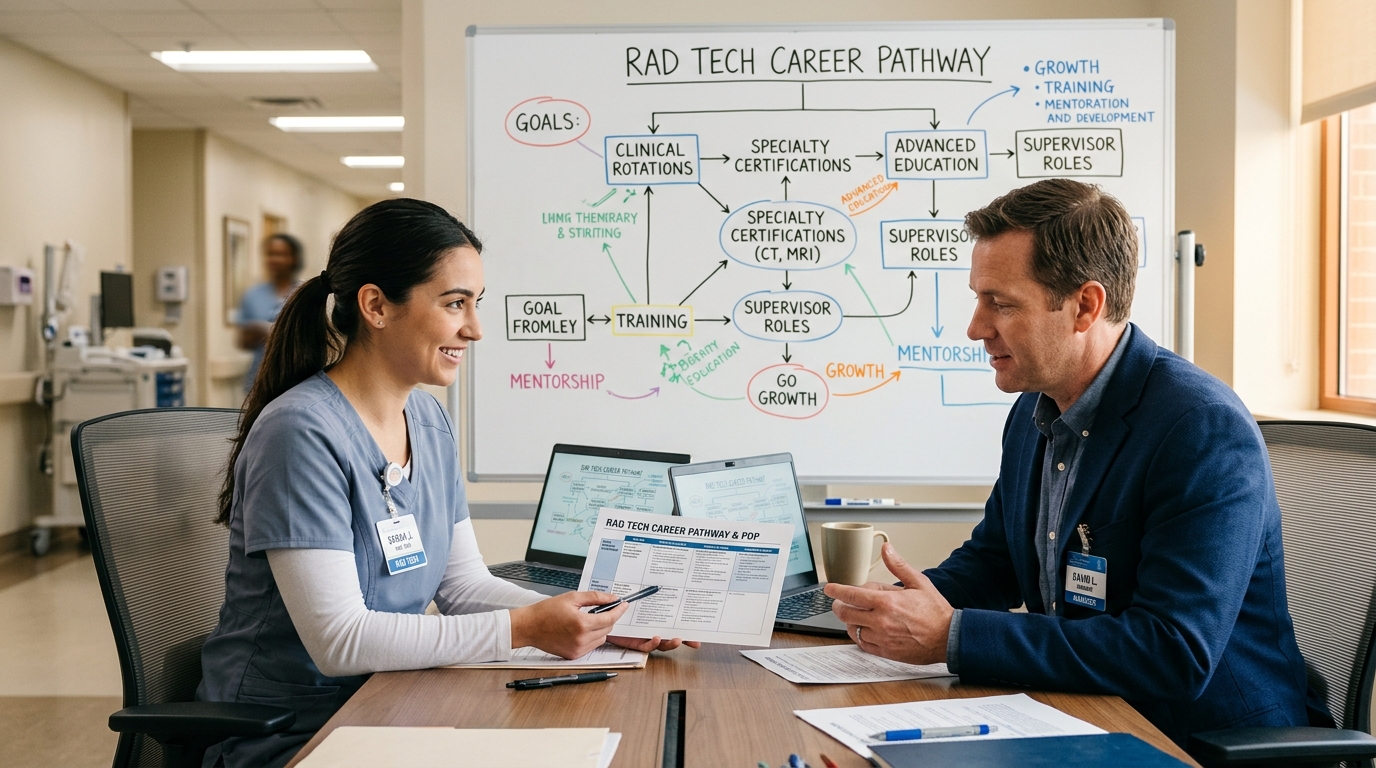
Why Most Techs Don't Have a Real Development Plan (And Why That Costs Them)
I work with rad techs at every career stage—fresh graduates, mid-career professionals looking to pivot, veterans wondering how to stay engaged. There's a pattern I notice: very few of them have an actual written development plan. They might have vague goals ("get better at ultrasound," "maybe pursue leadership someday"), but nothing structured, intentional, or measurable.
The cost of this is significant. Without a plan, you're reactive. You take the job posting that opens up. You grab the certification that sounds interesting. You say yes to the opportunity someone mentions because it seems better than what you're doing. You drift.
I spent eight years as an MRI technologist before transitioning into coaching, and I watched talented peers get stuck in exactly this way. They were good at their jobs—genuinely skilled. But they had no clear direction for where they were going, so they either stayed in the same role for a decade or made lateral moves that didn't actually advance anything meaningful.
Then I decided to get intentional about my own path, and it changed everything. I want to share that framework with you, customized for different career stages, because I genuinely believe that having a development plan—even a simple one—is what separates techs who feel stuck from techs who feel like they're building something.
Stage One: New Graduate (Years 0-2)
You just passed your ARRT exam. Maybe you did it right after your program. Maybe you worked as a non-certified tech for a bit first. Either way, you're new to actual clinical practice, and your primary job right now isn't career strategy. It's competence.
Your development plan at this stage should be about building fundamental skills and figuring out what you actually like.
Year One Goals:
- Achieve independence in all basic modalities your department performs (X-ray, fluoroscopy, CT, ultrasound, MRI—whatever applies to your setting)
- Complete orientation and any new-hire training requirements
- Get comfortable with basic troubleshooting and quality issues
- Build genuine relationships with your team and the radiologists you work with
Year Two Goals:
- Develop proficiency in your department's most complex procedures
- Identify one clinical interest (cardiac imaging, neuro, body, extremity—something that excites you)
- Complete your ARRT certification if you haven't already
- Formally request feedback from your supervisor on your performance
Certifications to Pursue:
- ARRT basic certification (obviously)
- One specialty certification in an area that interests you (CT, MRI, ultrasound, vascular-interventional)
What This Isn't About: It's not about fast-tracking to leadership or specializing in everything. You're exploring. You're building a foundation. You're figuring out if this profession actually fits you.
The Mistake New Grads Make: Taking a job without considering whether the institution values development. If your hospital won't pay for ARRT exam fees or has no clear mentoring structure, that's a red flag. You need an environment that invests in you right now, because you're investing heavily in getting good.
Stage Two: Mid-Career Technologist (Years 3-7)
You've been practicing for a few years. You're competent. You're probably good. And you're starting to ask yourself: what's next?
This is the stage where you have actual options, and you need to choose strategically. You could:
- Specialize deeper in your current modality
- Develop expertise across multiple modalities
- Move into leadership or education
- Pursue advanced certifications
- Transition entirely (like I did)
Your development plan here is about being intentional about which door you walk through.
Years 3-5 Goals:
- Develop advanced proficiency in your primary modality
- Pursue at least one additional specialty certification (if not already done)
- Seek out a mentor who's doing something you admire
- Take on one significant project or responsibility (training new hires, optimizing a protocol, etc.)
- Clarify whether you're interested in clinical depth or leadership trajectory
Years 5-7 Goals:
- If clinical depth: become the departmental expert in your area. Be the person people ask questions of.
- If leadership trajectory: take a supervisory or lead tech role, even informally. Develop your people management skills.
- Complete one significant continuing education beyond basic certifications (conference attendance, advanced course, etc.)
- Write down your five-year vision explicitly. Where do you actually want to be?
Certifications to Pursue:
- Multiple specialty certifications (trying on different areas to see what fits)
- Consider advanced certifications (RVT for vascular, RDMS for sonography, etc.)
- Leadership training if you're interested in that path
What This Stage Is About: Deliberately building toward a sustainable long-term trajectory. Not just doing your job well, but intentionally developing in a direction that excites you.
The Mistake Mid-Career Techs Make: Staying in a "safe" position too long because they're afraid of being unclear about their direction. Your future isn't built by accident. It's built by making conscious choices, even when those choices feel uncomfortable.
Stage Three: Senior Technologist (Years 8-15)
Now you've been in this profession long enough that you're good. Not just technically competent, but culturally competent. You understand the nuances. You see patterns. You know what quality really looks like.
This is when your development plan shifts from building skills to leveraging expertise and staying engaged.
Years 8-12 Goals:
- Become a recognized expert or leader in your department
- Formalize mentoring relationships (official preceptor role, if possible)
- Lead at least one significant clinical improvement project
- Develop proficiency in emerging technology in your field (AI integration, advanced cardiac imaging, latest MRI sequences—whatever's relevant)
- Clarify whether you want to continue growing clinically or transition toward administration/leadership
Years 12-15 Goals:
- If staying clinical: maintain expertise, mentor the next generation deliberately, contribute to departmental strategy
- If moving toward leadership: pursue formal management training, take supervisory responsibilities, develop your vision for what good imaging operations look like
- Publish or present something (case study, quality improvement project, research)
- Build a professional network beyond your institution
Certifications/Development:
- Staying current with ARRT requirements (CMEs)
- Consider formal education if moving toward administration (certificate programs, some pursue master's degrees)
- Advanced specialty certifications you didn't pursue earlier, if relevant
- Teaching credentials or train-the-trainer certifications
What This Stage Is About: Legacy and impact. You're far enough along that you can shape the profession around you. New techs learning from you. Processes you're improving. Problems you're solving.
The Mistake Senior Techs Make: Assuming the job stays interesting without intentional development. You have to keep feeding it. That's what keeps you engaged instead of just going through the motions.
Stage Four: Veteran Technologist (15+ Years)
You've been doing this a long time. You're probably excellent. You've seen technology changes, regulatory changes, profession evolution. You bring perspective.
The real question at this stage is: what kind of veteran do you want to be? The person who still loves the work? The mentor? The administrator? The person who transitioned entirely? The one who's stepping back?
Development Plan at This Stage:
- Explicit decision about your direction for the next 5-10 years
- If continuing clinical: what does mastery look like? What emerging areas interest you? How do you stay sharp?
- If mentoring: become intentional about it. Who are you developing? What are you teaching?
- If administration: are you moving toward department leadership, educational leadership, or something else?
- If transitioning: be thoughtful about that transition. What's your next chapter?
Focus Areas:
- Whatever you choose, make it deliberate. This is too late in your career to drift.
- Consider your impact on the profession. Conference presentations, writing, research, whatever form that takes.
- Be intentional about knowledge transfer. The things you've learned only matter if you're passing them on.
- Take care of yourself. Burnout is real, and it hits veterans hard sometimes.
The Temptation at This Stage: Coasting. You've earned it. You know how to do this job blindfolded. But coasting usually leads to frustration and a slow march to burnout.
Instead, actively choose what you're building in this final chapter.
Building Your Actual Development Plan: A Template
Here's what I recommend to the techs I work with:
Once a year, sit down and write:
Where I am now:
- Years of experience
- Current certifications
- Current role
- What's going well in my career
What I want to move toward (next 2-3 years):
- Specific skills I want to develop
- Clinical areas I want to know better
- Leadership roles I'm interested in (or not)
- Balance I'm seeking
What's required to get there:
- Certifications? Which ones?
- Education? Formal training? Self-study?
- Experience? Should I seek different cases, volunteer for projects?
- Relationships? Do I need a mentor? Should I mentor?
What I'll do this year to move forward:
- Specific, measurable actions (not "improve at ultrasound"—"attend two advanced sonography seminars" or "get certified in cardiac echo")
- When I'll do them
- How I'll know I've succeeded
What I'm explicitly not pursuing right now:
- This matters too. Saying no to things that don't fit your plan is as important as committing to things that do.
Keep this somewhere you review it quarterly. Adjust as needed. Share it with your supervisor or mentor, if you have one. Let it guide your decisions about which opportunities to take and which to decline.
The One Thing That Changes Everything
I've worked with hundreds of techs at this point, and the ones who feel most satisfied with their careers—regardless of where they are—are the ones who have intentionally decided where they're going instead of just reacting to opportunities.
Your development plan doesn't have to be complex. It doesn't have to be fancy. But it needs to exist, and it needs to be yours. Not what your manager thinks you should do. Not what you think you're supposed to want. What you actually want to build.
That's what a real development plan is.
Related Articles

Burned Out as a Rad Tech? Here's How to Reignite Your Career
April 23, 2026

Managing Up: How Rad Techs Can Influence Department Decisions
April 22, 2026

How to Compete With Travel Agency Pay Without Breaking Your Budget
April 22, 2026
Quality Assurance in Radiology: Why QA Culture Affects Retention
April 21, 2026