Night Shift Radiology: Survival Tips From a Tech Who's Been There
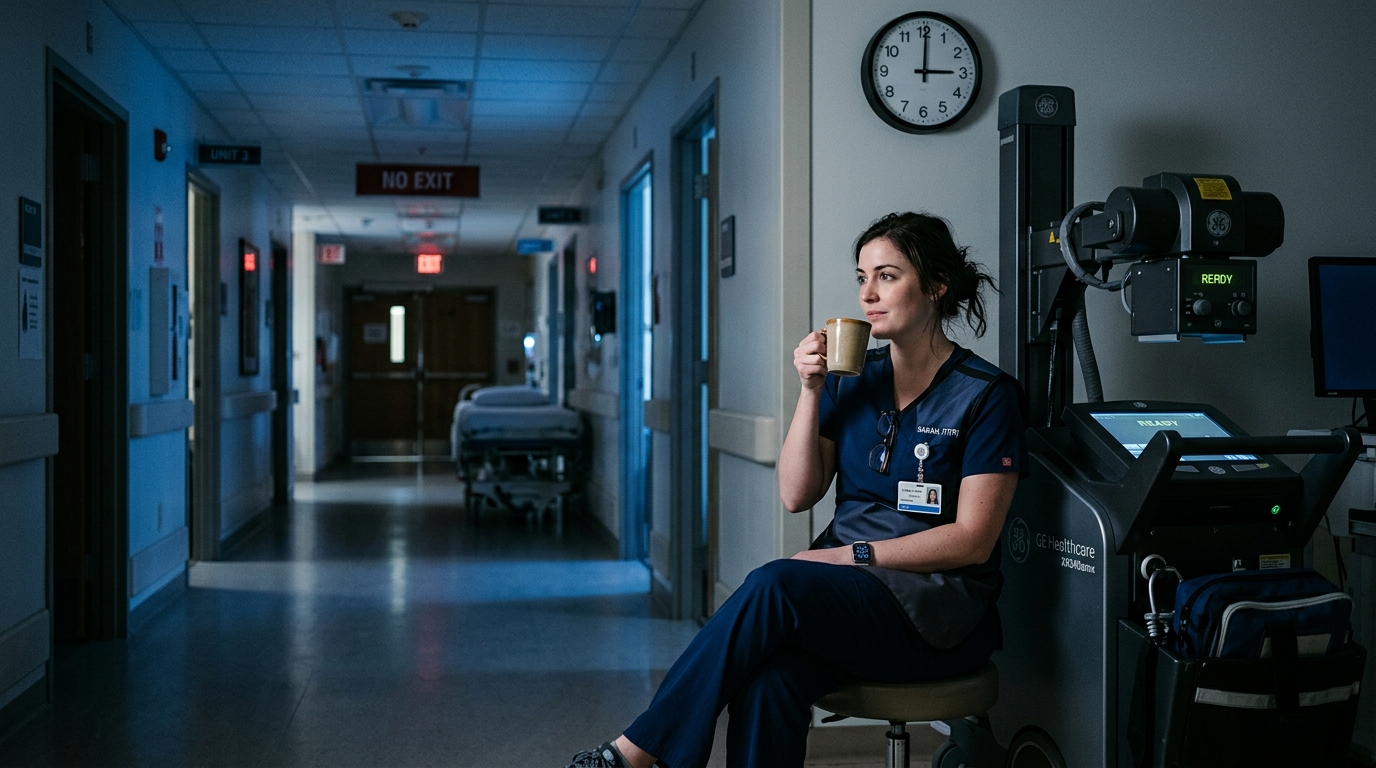
I'm going to be straight with you: I've spent roughly 4,000 nights working radiology. That's enough time in the dark to know both the transcendent and the terrible about overnight shifts. I'm not here to tell you it's amazing. I'm here to tell you how to survive it without destroying yourself.
My first night shift was a disaster. I showed up at 10 PM, exhausted after sleeping normally the night before, figured I'd just power through on coffee, and by 3 AM I'd made positioning errors I still cringe about. By 6 AM I was hallucinating—genuinely seeing double on monitor screens. I drove home in a state I wouldn't let my kids ride in a car with, and I called in sick the next night because I'd slept 18 hours straight and was still wrecked.
That was 1998. I've learned a lot since then.
The Sleep Thing: Non-Negotiable
Forget everything you think you know about sleep and night shifts. You're not going to be a superhero who adapts to flipped sleep. You're a mammal with circadian rhythms, and you're trying to work against one of the most primal biological systems you have.
Here's what actually works: sleep during the day like your life depends on it, because your career does.
When I started getting serious about this, I made a rule. Shift ends at 6:30 AM. I'm home by 7 AM. Blackout curtains, white noise machine, cool room temperature, and I'm asleep by 7:30 AM. Nonnegotiable. My family knows this is not optional. I get five to six hours before I need to be up. Not ideal, but sustainable.
The second block is crucial: a two-hour nap around 6 PM, right before I head in for shift. This isn't laziness. This is the difference between being safe and being a liability. After that second sleep, I have maybe four to five hours of actual alertness in me, which gets me through most of the shift.
A lot of new night shift techs try to sleep eight hours during the day and stay awake all evening with family. Sounds nice. Doesn't work. Your body gets confused. You'll crash hard during shift or fail to sleep the second time.
The math is: 5-6 hours during the day, 2 hours in the early evening, and that gets you to 7-8 hours total, which is barely enough but it's what works for most people working nights long-term.
Buy good blackout curtains. Not the cheap ones from the dollar store—real ones that make it look like midnight at noon. This alone made a bigger difference for me than any supplement.
Nutrition: You Can't Coffee Your Way Through This
I used to bring two Monsters and a Red Bull to every shift. I was wired, aggressive, and crashed hard by 5 AM. Now I bring water, a real meal around 2 AM, and a piece of fruit around 4 AM.
The reason night shift techs get that wrecked, hollow look isn't the hours—it's the garbage nutrition. You're raiding vending machines at 3 AM. You're grabbing whatever the hospital cafeteria has left from first shift. You're existing on caffeine because it's the only thing that feels like it's keeping you upright.
Meal prep before your shift block. I'm serious. Sunday night, I make four containers of actual food—proteins, vegetables, carbs. Nothing that's going to spike my blood sugar and crash. Grilled chicken, brown rice, roasted vegetables. Sounds boring. Keeps you functional.
Around 8 PM before heading in, I eat a normal dinner. Then at 2-3 AM, I eat one of my prepped meals. Nothing heavy, nothing that's going to sit in your stomach, but actual nutrition. Around 5 AM, some fruit. Banana is my go-to.
Coffee and energy drinks have their place, but they're not a meal replacement. I drink one good coffee at 10 PM before shift and maybe one more at 2 AM if it's been a rough night. More than that and you're borrowing energy from your body at interest.
The techs I know who thrive on nights all have one thing in common: they learned to cook or they prepared food. The ones who don't last usually rely on whatever's available, which is terrible.
The Emotional Toll Nobody Talks About
Night shift is lonely. I'll say it plainly because it's something nobody tells you before you start.
Your friends are asleep when you're awake. Your family is eating dinner without you. You miss your kid's game because you're working. You miss normal social events. You're awake at times when human activity is at its minimum.
This destroys some people psychologically. I've seen competent technologists leave the field because they couldn't handle the isolation. It's not weakness—it's just biology. We're social creatures and nights violate something fundamental about that.
Here's what helps: find your people. Find the other night shift techs. Become friends with them. Seriously. Around 2-3 AM, when everything is quiet and the world feels strange, you need someone who gets it. You need someone to grab a meal with at 5 AM. You need people who understand that you're exhausted because you've been working while everyone slept, not because you stayed out partying.
Some of my best friendships came from night shift. There's a camaraderie that develops when you're the skeleton crew. You trust the people around you more. You communicate differently. You develop inside jokes. It's weird but it's real.
I also made a rule: one day per week I adjust my sleep to normal schedule. Not every week—but roughly once a week, I flip. I stay up Friday night, sleep Friday day, stay awake Friday evening and Saturday, then resume normal night shift cycle. It's disruptive but it lets me maintain one day of normal human interaction. Some people can't do it. I need it.
Safety Things Nobody Emphasizes Enough
When I was young and stupid, I'd drive home exhausted, fighting sleep every mile. Once I actually nodded off at a red light. Another tech I knew had a minor accident. We're not immune to fatigue impairment just because we're professionals.
If you're too tired to drive safely, don't. Stay at the hospital. Take a nap in your car for 30 minutes. Call a cab. This isn't optional.
Also, the work itself gets riskier when you're tired. Patient positioning mistakes happen. You're more likely to needle stick yourself or get stuck with a sharp. You make communication errors with radiologists. After 10 years of nights, I learned to recognize my own fatigue point—usually around 4:30-5 AM—and I'm more careful. I'll double-check things I normally wouldn't. I'm honest with myself about when I'm not sharp.
And here's something else: night shift staffing is lean. You might be one of two techs for an entire hospital. If something goes wrong, you're handling it yourself. This is both the appeal and the terror of nights. You need to be hypervigilant about safety because there's no backup.
The Weird Benefits Nobody Expects
Here's what I didn't anticipate: night shift is where you actually get to practice your craft.
During the day, you're doing high-volume, routine work. Chest X-rays, simple CT protocols, standard positions. At night, when a patient comes in at 3 AM with a complex case, you're doing it. You're doing the trauma CT. You're the one figuring out the problem positioning for the post-surgical patient. You're learning more in one night than a day shift tech learns in a week.
I became a better technologist on nights. More confident. More independent. More skilled. Because I had to be. I didn't have four other techs to consult. I had a radiologist on call and myself.
Also, the money is better. Night differential might be $3-5 per hour depending on your hospital. Over a year, that's $6,000-10,000 extra. When I was building a life in my twenties, that mattered.
And the scheduling is weird but controllable. You work three nights, you're off four days. That's not a normal schedule but it's actually more time off than many day shift rotations. You can do things during the day that require business hours because you've got whole weekdays off.
When to Walk Away
Here's the hard truth: night shift isn't for everyone, and it doesn't stay manageable forever.
I know techs in their sixties still working nights. I also know techs who lasted two years and burned out hard. There's no shame in either. Your body changes. Your responsibilities change. Your capacity changes.
After about eight years, I moved to a mixed schedule—some nights, some days. After thirteen years, I'm mostly days with occasional night coverage. This is fine. Night shift was right for me in my twenties and thirties. It's not right for me now, and I'm okay with that.
If you find yourself consistently making mistakes, if you're getting sick constantly, if you're isolated and depressed despite trying the strategies—it might be time to transition. Talk to your manager. See if there's a mixed schedule option. It's not failure. It's knowing yourself.
But if you're new and you're struggling? Give it six months of genuine effort with these strategies. Sleep properly. Eat real food. Find your night shift crew. The transition is brutal but there's goodness on the other side if you can make it through.
Nights aren't for everyone. But if you're built for them, you'll know. And you'll have a career advantage that most techs don't have. You'll be the person who can handle anything because you already handle the hardest shift.
That's worth something.
Related Articles

Burned Out as a Rad Tech? Here's How to Reignite Your Career
April 23, 2026

Managing Up: How Rad Techs Can Influence Department Decisions
April 22, 2026

How to Compete With Travel Agency Pay Without Breaking Your Budget
April 22, 2026
Quality Assurance in Radiology: Why QA Culture Affects Retention
April 21, 2026