MRI Tech vs CT Tech: Which Specialty Should You Pursue?
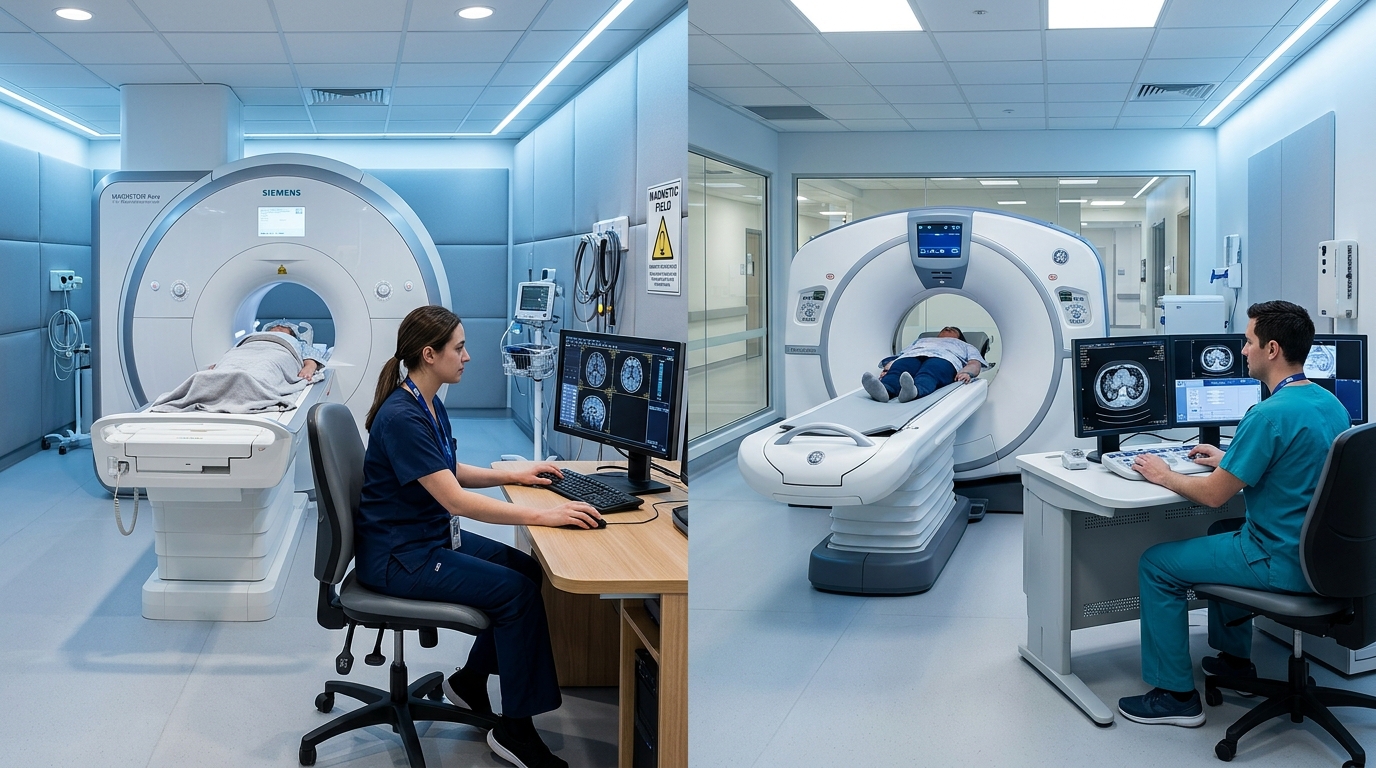
I've been an MRI technologist for over a decade, and in that time, I've coached hundreds of radiology professionals through one of the biggest career decisions they'll make: choosing between MRI and CT specialization. This isn't just about picking a machine to operate—it's about choosing a work environment, lifestyle, patient population, and long-term career trajectory.
If you're standing at this crossroads, you're not alone. Both paths offer excellent job security, competitive compensation, and meaningful work. But they're different in ways that matter deeply to your day-to-day satisfaction and professional growth. Let me break down what each specialty actually involves, so you can make an informed choice.
Understanding the Daily Work: What You'll Actually Be Doing
Let me be honest about what these jobs entail, because the marketing glossy doesn't match reality.
As an MRI technologist, your day revolves around the magnet. You're positioning patients inside a 1.5 or 3-Tesla scanner—sometimes 7-Tesla for research—and operating the console to acquire detailed images of soft tissue, organs, joints, and the brain. The work is precise and methodical. You'll spend considerable time with each patient: explaining the procedure, addressing their claustrophobia concerns, positioning them perfectly, and then monitoring them during the scan, which can take 30 minutes or longer. You're constantly problem-solving—troubleshooting artifacts, adjusting sequences, and communicating with radiologists about image quality.
CT technologists, by contrast, work at a faster pace. You're positioning patients in the scanner, acquiring volumetric images quickly, and moving to the next patient. A CT scan might take 30 seconds to 5 minutes total. You'll see more patients in a shift—sometimes significantly more. The work is efficient and rhythmic, which some techs love and others find unsustainably rushed.
The patient interaction is genuinely different. MRI requires more hand-holding and reassurance; many patients feel anxious in that enclosed space. CT patients are usually in and out, which is great for throughput but less opportunity to build rapport.
Certification and Educational Requirements
Both specialties require specific ARRT (American Registry of Radiologic Technologists) certifications beyond your basic R.T. certification.
MRI certification requires the ARRT MR credential. You'll need a minimum of 24 months of clinical experience in MRI and 200 hours of structured education before you're eligible to sit for the exam. Many programs require more. The exam covers MRI physics, safety (this is critical—you're working with powerful magnets), patient management, and image production. Studying for this exam typically takes 3-6 months of serious preparation.
CT certification requires the ARRT CT credential. The educational path is slightly shorter: you need 24 months of clinical experience and 200 hours of education minimum, though again, many programs exceed this. The exam covers CT physics, protocols, contrast media, patient care, and image interpretation. The material is substantial but different in nature—less about magnetic field interactions, more about radiation dose optimization and contrast administration.
Both certifications are legitimate challenges. Neither is a "quick add-on." Both require real study and skill development. There's no shortcut, and honestly, that's good—these are complex modalities.
Real Talk on Salary and Compensation
Let's address money directly, because it matters.
MRI technologists currently earn a median salary of approximately $75,000-$85,000 annually, depending on location, experience, and facility type. In major metropolitan areas and specialized imaging centers, I've seen positions advertised at $90,000-$105,000. Night shift differentials can add $3,000-$8,000 annually. Some facilities offer $5,000-$10,000 sign-on bonuses, particularly in competitive markets.
CT technologists typically earn $68,000-$78,000 as a median, but don't let that scare you. In high-demand markets and hospital systems, CT positions often hit $80,000-$95,000. The differences are regional and facility-dependent more than specialty-dependent. Travel CT contracts are incredibly lucrative—I've coached techs earning $2,000-$3,000 weekly on short-term travel assignments.
The bottom line: salary is roughly equivalent between the two specialties. Your earning potential depends more on geography, facility type, shift preferences, and willingness to travel than on which specialty you choose.
Job Market Demand: Where Are the Opportunities?
This is where things get interesting—and where your choice can significantly impact your job flexibility.
The CT job market is hotter right now. CT is everywhere: emergency departments, imaging centers, outpatient facilities, surgery centers, even some urgent care clinics. The job growth for CT continues strong. If job security and abundant opportunities matter to you, CT wins this round.
MRI positions are more concentrated in hospitals and specialized imaging centers. The job market is solid but less ubiquitous than CT. However—and this is important—MRI positions tend to be more stable, with lower turnover and stronger retention at facilities that have them. MRI scanners are expensive pieces of equipment, so facilities invest heavily in training and keeping their MRI teams. You're less likely to see layoffs in the MRI department.
For location flexibility, CT gives you more options. For job stability and workplace investment in your development, MRI often edges ahead.
Work Environment: The Reality of Safety, Pace, and Stress
This is where personal fit becomes crucial.
MRI work environment means constant awareness of magnetic safety. You're managing metallic implants, ferromagnetic foreign bodies in patient eyes, and strict protocols around what enters the magnet room. This requires vigilance but becomes routine. The pace is measured. You're not rushing between patients; you're crafting quality images and ensuring patient comfort. For introverts and detail-oriented techs, this environment is ideal. For people who thrive on high-volume, high-energy work, it can feel slower than desired.
The elephant in the room: MRI quench events (when the magnet is vented to open air—dangerous and expensive) and occasional claustrophobic patients create stress. You'll manage difficult situations, and occasionally things go wrong.
CT work environment is faster-paced and higher-volume. You're managing radiation exposure—both for patients and yourself—which requires discipline around protocols and dose optimization. The environment is busy; emergency departments with CT scanners are hectic places. For extroverts and people who enjoy constant movement, this is energizing. For those who prefer depth over breadth, it can feel fragmented.
Both environments have stress; it's just different stress. MRI stress is often quiet and technical; CT stress is often about managing volume and acuity.
Patient Interaction and Population Differences
MRI attracts a different patient demographic in many ways. You're scanning joints, doing MRIs of the brain for neurological issues, cancer surveillance, sports injuries—often patients are relatively stable. The scan takes time, so you build brief relationships. You become skilled at managing anxiety and claustrophobia. This is rewarding for techs who want genuine patient interaction.
CT patients are often sicker or more acute. Emergency departments, trauma, acute strokes—you're working with higher-acuity populations in many settings. The interactions are briefer but intense. It's less about relationship-building and more about efficiency and accuracy in urgent situations.
Neither is better—they're different. Know which environment energizes you.
Advancement Opportunities: Where Can Each Path Take You?
Both specialties offer advancement, but the routes differ.
From MRI, you can advance into:
- MRI supervisor or manager roles
- MRI physics specialist positions
- Research MRI technologist roles
- Clinical applications specialist (vendor-facing positions)
- Teaching or didactic roles at schools
- Medical sales roles with imaging manufacturers
From CT, you can advance into:
- CT supervisor and department management
- Protocol development specialist roles
- Image quality and radiation dose optimization roles
- Research assistant roles (especially in clinical trials)
- Travel assignment leadership positions
- Vendor applications specialist roles
Both specialties have ceiling-less potential if you pursue additional education (like bachelor's degrees or specialized certifications). Many employers now prefer or require bachelor's degrees for management tracks—this applies equally to MRI and CT advancement paths.
The Personality Fit: Who Thrives in Each Specialty?
Here's my coaching perspective after working with hundreds of techs:
MRI technologists typically thrive if you:
- Enjoy problem-solving and troubleshooting
- Prefer depth over breadth in your work
- Are detail-oriented and methodical
- Don't mind slower-paced, longer interactions
- Are genuinely interested in physics and how things work
- Are comfortable with continuous learning (MRI is always evolving)
- Enjoy one-on-one patient care
CT technologists typically thrive if you:
- Enjoy high-volume, high-efficiency work
- Are adaptable and comfortable with change
- Prefer faster pace and more variety
- Are strong at multi-tasking
- Work well in acute-care environments
- Are collaborative in team-based settings
- Don't need deep relationships with each patient
That said, these are tendencies, not rules. I've coached introverts who love CT and extroverts who are excellent MRI techs.
The Option Nobody Talks About: Pursuing Both Certifications
Here's something to consider: you don't have to choose just one forever.
Many successful imaging professionals pursue both the ARRT MR and CT certifications. You gain credibility, flexibility, and marketability. You can work both modalities, understanding their complementary roles in patient care. Some facilities actually prefer this, as it allows scheduling flexibility and cross-training.
The timeline? You can pursue both certifications sequentially over 2-3 years, or sometimes more quickly if your facility provides structured education. This approach is particularly valuable if you're early in your career and uncertain about your long-term preference.
Making Your Decision: The Practical Framework
Here's how I recommend approaching this:
Shadow both modalities if possible. Spend a shift with an MRI tech and a shift with a CT tech. Experience the pace, environment, and daily work firsthand.
Assess your non-negotiable factors: What matters most—job availability, salary, pace, patient interaction depth, work-life balance, location flexibility?
Consider your learning style: Do you want to master one specialty deeply (MRI) or work across multiple applications (CT)?
Evaluate your long-term vision: Are you building toward management? Teaching? Specialization? Each specialty has different advancement pathways.
Start with your facility's needs: If your current employer is desperate for MRI techs and offering education support, that's a significant advantage.
Remember this isn't forever: You can start with one specialty and transition later if needed. Your first choice doesn't lock you into a path.
Final Thoughts
After years in MRI and coaching professionals through this decision, I can tell you this: both are excellent careers. Both offer stability, meaning, and respectable compensation. Neither choice is "wrong."
The right choice is the one that aligns with how you want to work, learn, and grow. If you're methodical and love solving technical puzzles, MRI will likely satisfy you. If you're energized by high-volume work and acute situations, CT might be your fit.
The good news? Radiology is growing. There's demand for both specialties. Choose based on your personality and preferences, not scarcity. Your satisfaction matters more than any other factor.
Take the time to really think about this decision. Talk to technologists in both fields. Shadow if you can. And remember—this is your career, your time, and your professional satisfaction on the line. Choose thoughtfully.
Ready to find your ideal MRI or CT position? Browse hundreds of specialty-specific radiology tech jobs on RT Job Bank. Whether you're pursuing your first certification or transitioning between specialties, our job board connects you with facilities actively recruiting for both MRI and CT technologists. Start your search today and find the role that matches your specialty choice.
Related Articles

Burned Out as a Rad Tech? Here's How to Reignite Your Career
April 23, 2026

Managing Up: How Rad Techs Can Influence Department Decisions
April 22, 2026

How to Compete With Travel Agency Pay Without Breaking Your Budget
April 22, 2026
Quality Assurance in Radiology: Why QA Culture Affects Retention
April 21, 2026