The Gig Economy Hits Radiology: Platform Staffing Pros and Cons
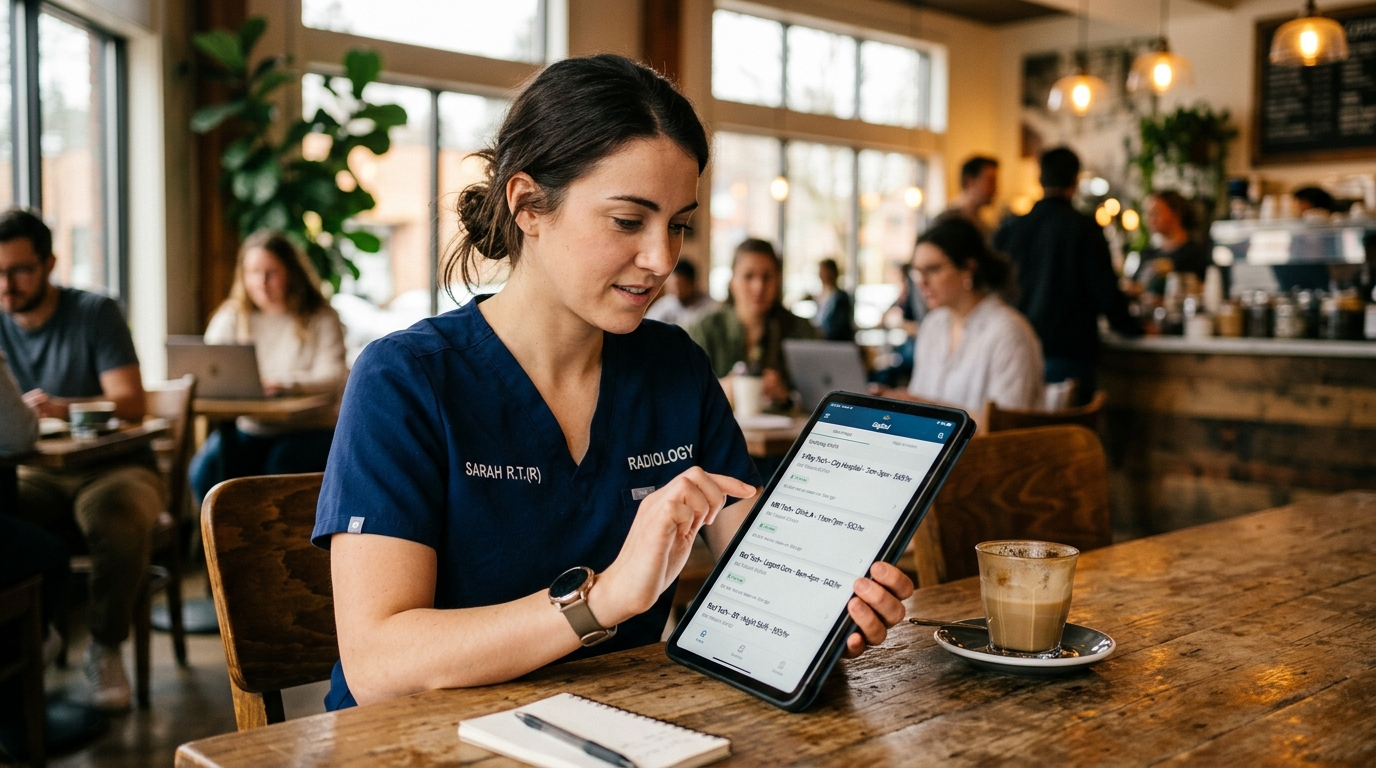
I remember when a department going "short staffed" meant frantically calling people at home at 6 AM. Now it means opening an app.
Five years ago, I watched the gig economy transformation happen in travel radiology—Uber had already proven the model worked, and someone finally thought: why not healthcare? Today, platforms like Aya, ShiftMed, and Nomad are genuinely reshaping how radiology departments find bodies for open shifts. As someone who spent eight years as a traveling rad tech and now works as a staff educator watching this ecosystem mature, I've got a front-row seat to both the promise and the problems.
Here's what I'm seeing on the ground, and why this matters more than you might think.
How Platform Staffing Actually Works
Let's start with the mechanics because they're not complicated, but they're consequential.
A rad tech opens an app, sees that Regional Medical Center's CT lab needs someone for tomorrow from 2 PM to 10 PM, and books the shift in literally 90 seconds. The hospital gets filled coverage. The tech makes $28-$42 per hour (depending on demand and urgency), takes the gig, or scrolls to the next one. Payment goes through within 24-48 hours, direct to their account.
Compare that to the old system: manager calls eight people's personal phone numbers, leaves voicemails, waits for callbacks, negotiates, maybe gets one yes. Takes 40 minutes of her time. Happens at 6 AM when nobody's awake.
From the department's perspective, having a platform that can reliably fill gaps is genuinely helpful. When I was doing per diem work ten years ago, some hospitals literally lost revenue because they couldn't get techs in for afternoon shifts. Having access to 300+ available techs at any given moment in a metro area? That's operationally significant.
The first hospital I worked with that went all-in on ShiftMed reported filling 87% of open shifts within 24 hours—versus 64% through traditional phone calling and their existing per diem staff. That's real money. That's fewer cancellations. That's scheduling certainty.
The Tech's Perspective: Freedom With Friction
For rad techs, the appeal is obvious. I've talked to technologists who use these platforms as their primary income source, and I've talked to staff techs who pick up shifts on the weekends to cover a car payment. Both use cases exist, and both get value from it.
The flexibility argument is legitimate. A tech with young kids can look at the schedule Tuesday night and see what work fits her life this week, rather than committing to a department schedule three months out. A tech building specialization hours in interventional radiology can target IR-specific shifts and actually advance their credential in a deliberate way. A tech dealing with burnout can step back to two shifts per week instead of quitting entirely.
I know a tech in Denver who does exactly this. She was burned out on the grind of full-time department work—the meetings, the politics, the mandatory evening shifts. Now she does 16-20 hours per week across three different hospitals using platform work. Better pay-per-hour, more control, and she actually wants to be there when she works. She told me it saved her career.
But here's the friction: these platforms take a cut. Usually 20-30% of what the hospital pays goes to the platform. So if ShiftMed charges a hospital $42 for a tech's shift, the tech might get $28-32. It's still better than traditional per diem in most markets ($18-24), but it's not true freelance freedom. You're not getting the full $42.
There's also the consistency problem. Monday you've got five shifts lined up. Wednesday it's one. Income becomes less predictable than a part-time staff role. And there's zero benefits. No health insurance, no 401k, no paid time off. The platform isn't your employer, so you're navigating your own insurance marketplace if you're doing this as your primary work.
What's Actually Happening Inside Departments
Here's where my observations get more critical.
I was brought in as a consultant at a 300-bed hospital last year that had gotten dependent on platform staffing. They went from 23% per-platform shifts to 67% of their coverage through apps within 18 months. The director loved it—no recruiting headaches, no turnover management, just open shifts filled instantly.
Except the department was increasingly fragmented. New faces every day. No institutional knowledge. Training new people on their PACS system took 20 minutes each. Continuity was gone. The permanent staff—the seven people who actually ran the department—were increasingly exhausted because they had to constantly orient temps and cover gaps that the platform didn't fill.
One of their senior techs told me, "I went from working with a consistent team to babysitting strangers." She left six months later.
This is the actual cost most departments aren't factoring in: platform staffing is great for filling gaps, but if you use it to replace your core scheduling function, you hollow out your team. Your core staff become the reliable center holding everything together, working harder because they're constantly onboarding, and eventually they leave.
I've also noticed platform techs often come in less invested in quality. They're not there for the career or the relationships—they're there for the paycheck. Which is completely fine and fair, but it changes the culture. Code blues need everyone locked in. Difficult procedures need trust. A tech working a one-off shift doesn't have the same skin in the game as someone who works there every Tuesday and Thursday.
The Real Pros for Departments
Let me be fair here, because platform staffing does solve legitimate problems.
Surge capacity. When flu season hits or you're dealing with unexpected demand spikes, you can actually scale. Most departments are chronically understaffed, and platforms give you emergency breathing room.
Reduced recruitment burden. Hiring is expensive and slow. If you need bodies, platforms fill the gap while you're recruiting. I've seen departments use this strategically—use platform staffing for the unpredictable shifts while they recruit core FTEs. That's smart.
Crisis coverage. Someone calls in sick. A tech quits with a week's notice. A platform gives you coverage immediately instead of canceling patients.
No training cost for temporary needs. If you only need one extra person for three weeks during a construction project, platform staffing beats hiring someone you'll lay off later.
These are real wins. I'm not dismissing them.
And the Real Cons for Everyone
But there are costs that don't show up on the spreadsheet.
Loss of continuity and culture. Every platform tech is a slightly-reinvented-wheel training session. Your department's culture becomes diffuse.
Quality variability. Some platform techs are excellent. Some are... less so. You get what you get. No ability to really invest in someone's development.
Turnover acceleration of core staff. When core staff feel like temps and temps feel like the norm, your good people leave. I've seen this repeatedly.
Hidden platform costs. It's not just the 20-30% commission. It's the time your manager spends checking if shifts are filled, coordinating with platform dispatch, dealing with no-shows, managing the complexity of multiple systems. I've calculated it at about $8-12 per shift in indirect labor cost at most hospitals.
Dependency risk. What happens if Aya changes their pricing model? What if they pull out of your market? Several smaller platforms have already consolidated or shut down. Becoming dependent on a private company for your core scheduling function is a bet.
Licensing and credentialing complexity. Not every platform tech is credentialed everywhere they work. Liability questions are still murky.
Finding the Real Balance
The honest answer is that platform staffing isn't good or bad—it's a tool that becomes good or bad depending on how you use it.
Used as a true gap-filler for unexpected shifts and surge periods? It's genuinely useful. Used as a primary scheduling strategy to avoid investing in your core team? It's a productivity illusion that eventually costs you your best people.
The successful departments I see use platforms strategically. They keep their core team lean but solid—maybe 18-20 FTEs who form the backbone. They use platforms to fill predictable gaps and surge needs. They invest heavily in keeping their core team happy because they know they can't operate without them. Platform work is supplementary, not foundational.
The unsuccessful ones drift into dependency. They slowly stop recruiting because platforms are easier. Their core team atrophies. Then when they finally realize they need to build real capacity, they've lost the institutional knowledge and culture that makes a department work.
What This Means for Hiring Managers
If you're hiring right now, here's what I'd consider: platforms are great for flexibility and filling gaps, but they're not a substitute for a real team. Invest in recruiting genuinely good rad techs for permanent roles. Use platform staffing to fine-tune capacity, not to replace it. And watch your core team's burnout closely—they're the ones who make the difference.
The gig economy didn't break radiology. But it can, if we use it to avoid building real teams instead of using it to support the teams we have.
The future probably looks like this: solid core staff, intentional platform supplementation, and departments that are honest about how much they're actually relying on each. That's the sustainable model.
Everything else is just kicking the recruiting problem down the road.
Related Articles

Burned Out as a Rad Tech? Here's How to Reignite Your Career
April 23, 2026
Managing Up: How Rad Techs Can Influence Department Decisions
April 22, 2026

How to Compete With Travel Agency Pay Without Breaking Your Budget
April 22, 2026
Quality Assurance in Radiology: Why QA Culture Affects Retention
April 21, 2026