Your First Rad Tech Job: What to Expect and How to Crush Your First 90 Days
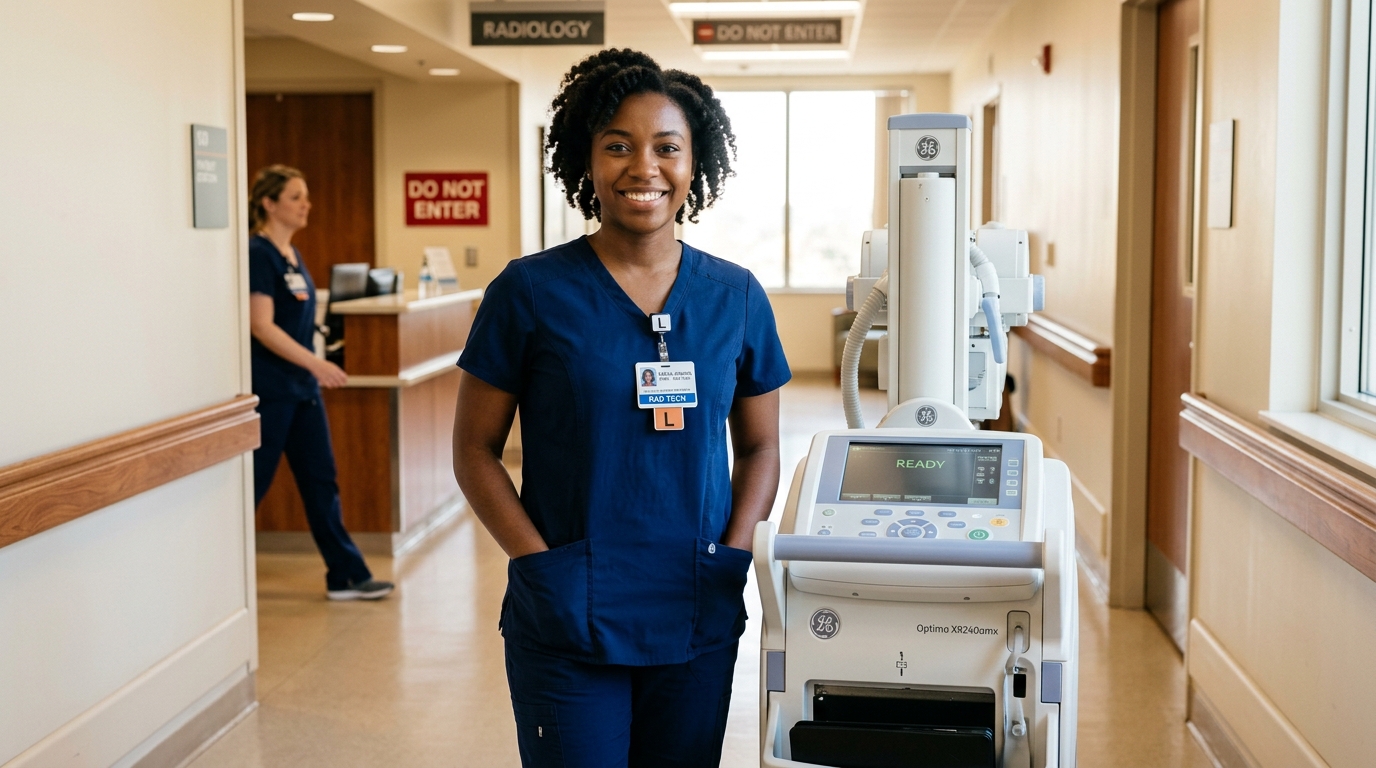
Congratulations. You passed the ARRT. You nailed the interview. You're holding an offer letter for your first position as a radiology technologist. You're probably feeling some combination of excitement, relief, and—let's be honest—absolute terror.
That's normal. I felt the same way on my first day, standing in the employee break room at 6:45 a.m., wondering if I'd made a huge mistake. Spoiler: I hadn't. And you won't either, as long as you go in with realistic expectations and a willingness to learn.
The gap between what you learned in school and what you'll encounter on the floor is real, significant, and totally manageable. Here's what I wish someone had told me when I started—and what I now tell every new graduate who walks into one of my departments.
The School-to-Floor Reality Check
Your didactic program and clinical rotations prepared you well for the technical side of rad tech work. You understand anatomy, pathology, radiation protection, and positioning. That foundation is solid and valuable.
But school is a controlled environment. Clinical preceptors knew you were coming. Radiologists were expecting questions. Patients were usually cooperative and weren't dealing with the stress of a genuine medical emergency. Turnaround times were reasonable. Equipment didn't break down (or when it did, someone else fixed it).
The real department? It's faster, messier, more complex, and infinitely more human than anything you practiced. Every facility has its own culture, workflow, equipment preferences, and unwritten rules that you won't find in your textbooks. The protocols your school taught you are a foundation, but your specific department's protocols—the ones your attending radiologist expects you to follow—are what you actually need to master.
This isn't a failure of your education. It's the nature of transitioning from training to work. And understanding this gap mentally is the first step to closing it quickly.
Week One Survival: Ask, Listen, and Remember Names
Your first week isn't about proving you know everything. It's about proving you're coachable, reliable, and genuinely interested in doing the job well.
Ask questions constantly. I'm not exaggerating. Your preceptor, the senior techs, the radiologists—they expect new graduates to ask questions. They're watching to see if you'll try to wing it when you're unsure, because that's actually a red flag. Asking shows you prioritize accuracy and safety. Ask about protocols. Ask about where supplies are. Ask why a particular position is preferred even if it differs slightly from what you learned. Ask about abbreviations you see in the system. Every single question is an investment in doing better next time.
Learn people's names immediately. Sounds simple, but it's transformative. Make a point to learn your preceptor's, your technologist colleagues', and the radiologists' names within the first few days. Use them. "Hey, Sarah, I'm heading to CT—do you have a moment?" People notice and respond to being recognized as individuals. This matters more than you realize for long-term relationships and support.
Find a mentor early. This might be your official preceptor, or it might be a senior tech who takes you under their wing. A mentor is someone who has navigated the exact same department, understands its quirks, and is willing to give you honest feedback. You want someone who'll tell you when you're about to do something that will cause problems, not someone who just smiles and lets you learn by disaster. Cultivate that relationship.
Observe the unwritten rules. Every department has them. Maybe lunch coverage is sacred and nobody schedules non-emergency work during 12-1 p.m. Maybe there's a particular radiologist who wants plain films loaded a specific way. Maybe senior techs use certain equipment and newer techs use other equipment. Maybe there's a rotation for taking difficult patients. Watch, listen, and figure out how things actually work before you try to do things differently.
The Mistakes New Techs Make (And How to Avoid Them)
Over the years as an educator, I've seen the same patterns repeat. New graduates tend to make one of three critical mistakes:
The Overconfidence Trap
You passed your exams. You know positioning. You know physics. So you dive in trying to prove yourself, fast, independent, and minimizing questions. This usually manifests as taking shortcuts—maybe loading QA images without the right information, or assuming you know what view the radiologist wants without asking. Overconfident techs create rework, frustrate radiologists, and develop bad habits fast.
Stay humble. You don't know your department yet. You don't know your attending radiologists' preferences. You don't know which corners are safe to cut (there are some) and which ones will create chaos. Being the "I'll just figure it out" new grad might save you 30 seconds per exam, but it creates problems downstream.
The Fear Spiral
The opposite mistake is becoming so afraid of doing something wrong that you freeze. You move slowly, you don't take initiative, you wait for permission to use any piece of equipment. You apologize constantly. This exhausts you and signals to the team that you're not confident.
There's a middle ground: be methodical and ask about ambiguous things, but move with purpose. Own the exams you're assigned. Use the equipment you've been trained on. Make decisions about positioning with the knowledge you have. Ask a supervisor if something feels genuinely wrong—but don't ask permission for routine work.
The Workflow Revolutionary
"At my school, we did it this way, which is better." or "I read this new article about positioning that changes everything." New techs sometimes arrive with fresh knowledge and immediately want to improve established workflows. Even if you're right, this creates friction.
Learn the current workflow first. Do it their way for weeks before suggesting anything changes. Build trust and credibility. Eventually, good ideas will be heard. But on week two, proposing changes reads as arrogance, not innovation.
Building Real Relationships With Your Team
Radiology is a team sport. You work with radiologists, sonographers, nurses, CT techs, nuclear medicine techs, and administrative staff. You depend on each other constantly.
The technologists above you in experience aren't competitors—they're your safety net and your future colleagues. The radiologists aren't gatekeepers judging you—they're specialists who need good, consistent information from you to do their jobs. Build these relationships genuinely.
Offer to help when others are slammed. Show genuine interest when senior techs explain things to you. Be reliable about scheduling, shifts, and follow-through. Don't gossip or complain to new people quickly—observe culture before you participate in it. Bring small, thoughtful gestures sometimes (donuts, helping someone cover a break). These aren't about being fake; they're about showing respect and investment.
Most importantly: when you make a mistake (and you will), own it immediately, apologize, and explain what you'll do differently. People forgive mistakes. They don't forgive people who blame others or hide problems.
Mastering Your Specific Department's Protocols
Your textbook taught you one way to position a lumbar spine. Your department might prefer a slightly different angle, different technique factors, different view order. Your attending radiologist might have preferences you've never heard of. The PACS system might work differently than your school's. Your equipment is calibrated specifically to your facility.
Spend the first 30 days documenting your department's specific protocols. Write them down. Create a small reference guide for yourself. Ask the radiologists what matters most to them in the imaging you produce. Some radiologists care deeply about exact positioning; others are flexible as long as the anatomy is clear. Some want scouts first; others want it different. Some departments do fluoroscopy studies one way; the hospital down the street does it completely differently and both ways are fine.
This isn't rote memorization—it's understanding the "why" behind local decisions and integrating into your department's specific culture and workflow. This is what will actually make you functional and valuable at your specific job.
Your First Difficult Patient (And There Will Be One)
At some point in your first weeks, you'll encounter a patient who is anxious, in pain, confused, uncooperative, or all of the above. They might refuse to move correctly for positioning. They might cry. They might be rude. Your textbook didn't really prepare you for this, even though patient interaction is a core part of the job.
Here's the reality: difficult patients aren't personal attacks on you. Patients are usually scared or hurting. A calm, clear explanation of what you need and why helps tremendously. "I need you to turn onto your right side so we can see your spine clearly" is better than "Turn right." Giving them control when possible helps—"Can you lift your arm higher, or should I help?" Respect their dignity.
When a patient becomes truly uncooperative or abusive, that's when you involve your supervisor or radiologist. You're not equipped to handle behavioral crises—nobody expects you to be. Document what happened, report it, and move forward.
The emotional weight of handling a difficult interaction is normal. You might replay it, feel anxious, question whether you handled it right. This fades as you gain experience and realize that difficult patients are common, manageable, and not a reflection of your competence.
Managing the Emotional Weight of Medical Imaging
Radiology tech work is emotional labor that isn't always acknowledged. You're seeing people at vulnerable moments. You're occasionally involved in the discovery of serious pathology—someone's diagnosis happens partially during your exam. Pediatric cases hit differently. Trauma cases are heavy. End-of-life patients deserve a different kind of care than routine exams.
There's also the cumulative emotional burden of being around human suffering, even peripherally, every day. By week four, you might notice you're more tired than the workload should make you. That's normal. You're processing human emotion constantly.
Talk to colleagues about this. Experienced techs have systems for managing it. Some compartmentalize. Some journal. Some exercise hard. Some just talk it through with other techs over lunch. Find what works for you. Your mental health matters, and recognizing that imaging work carries emotional weight is actually a sign of empathy and awareness that will make you a better tech.
Setting Career Goals Early (Even if You Don't Know What They Are Yet)
In your first 90 days, start thinking about what you want this job to be. Is this a stepping stone? A long-term career? Are you interested in eventually specializing (CT, MRI, nuclear medicine, ultrasound)? Do you want to eventually teach, manage, or work as a travel tech? Are you exploring what fits, or do you have a five-year plan?
You don't need answers to all of these now. But having a direction—even a loose one—helps you approach your work differently. If you're interested in CT, volunteer to observe and assist when you get the chance. If you're thinking about education, start noticing how your educators teach. If you're considering travel tech work (and I recommend everyone does at some point), pay attention to how different departments run.
Your first job doesn't determine your entire career, but it shapes it. Thinking deliberately about what you want helps you make the most of the opportunity.
Knowing When You're in the Right Place (or Not)
By day 60 or 70, you'll have enough clarity to know whether this is a good fit. Good departments feel chaotic initially but gradually make sense. Radiologists engage with you. Senior techs invest in your growth. People stay employed there (low turnover is the strongest sign). Equipment works. Patients are treated with respect. People seem glad to be there.
Bad department fits feel chaotic and never quite click. Radiologists are dismissive or don't engage. Senior techs seem resentful or competitive. Turnover is high. Equipment breaks constantly and nobody fixes it. People seem angry or checked out. You feel drained in ways that aren't just normal first-job adjustment.
The first 90 days is your real trial period. Most contracts have probation for exactly this reason—so you can figure out if this fits before you're locked in. If it's not working, it's okay to start looking. You're not a failure if the first placement isn't the right one. You'll learn something valuable and you'll find a better fit.
Your First 90 Days Matter, But They're Not Everything
Finally, this: your first three months is a crucial foundation, but it's not a pass-fail verdict on your career. New grads who are struggling in week three can be confident, competent techs by month four. People who look exceptional initially sometimes flame out because they never built real relationships or developed good habits.
What matters most is trajectory and attitude. Are you improving week to week? Are you building relationships? Are you taking feedback and adjusting? Are you showing up reliably and putting in genuine effort? These are the things that determine long-term success, not whether you nailed your first exam or made mistakes in your first week.
You've got this. Take it one day at a time, ask for help, be genuinely interested in learning, and remember that every single experienced tech in your department started exactly where you are now. They made mistakes. They felt overwhelmed. They survived and so will you.
Welcome to the profession. We're glad you're here.
Related Articles

Burned Out as a Rad Tech? Here's How to Reignite Your Career
April 23, 2026

Managing Up: How Rad Techs Can Influence Department Decisions
April 22, 2026

How to Compete With Travel Agency Pay Without Breaking Your Budget
April 22, 2026
Quality Assurance in Radiology: Why QA Culture Affects Retention
April 21, 2026