Creating Flexible Scheduling That Works for Rad Techs and Your Department
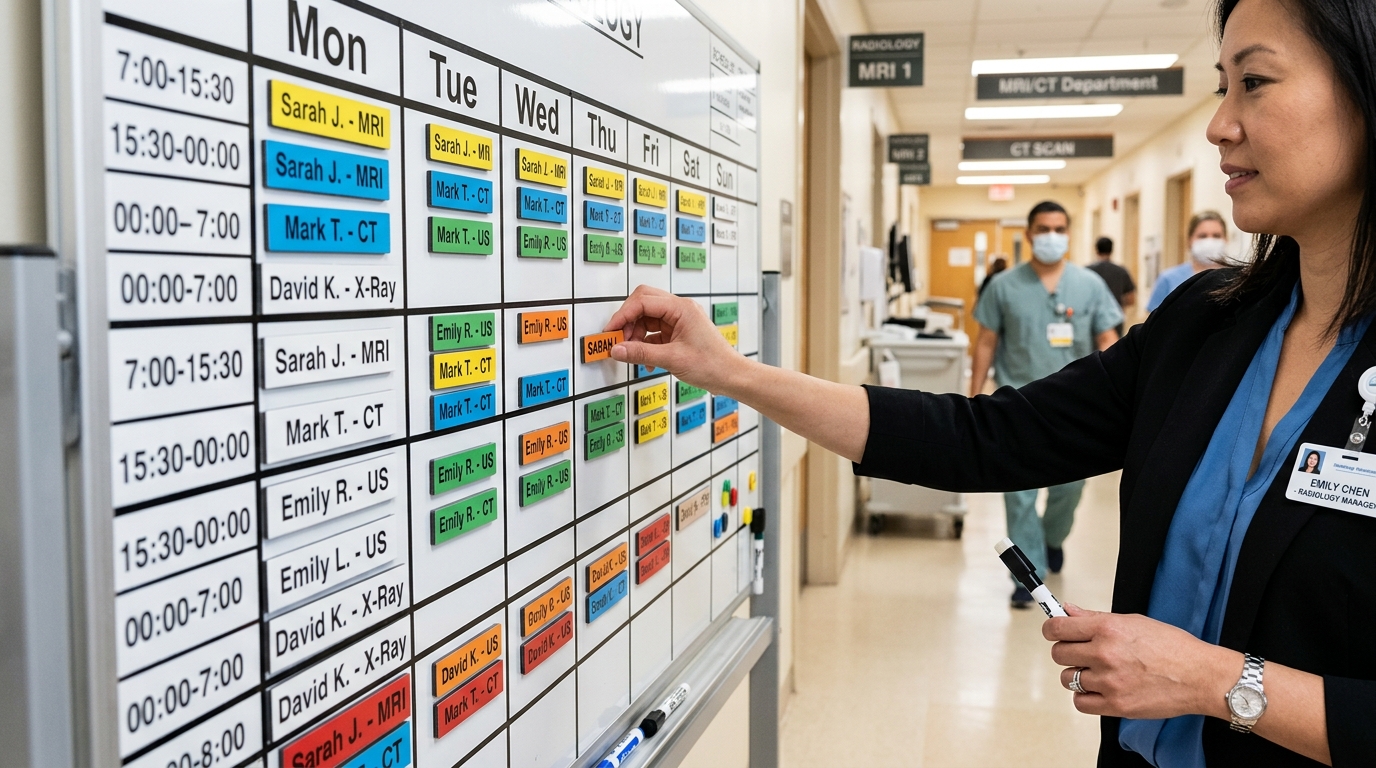
I remember the exact moment I decided to go into travel assignments. It was 6 p.m. on a Tuesday, and my daughter's school called to say she'd been waiting at pickup for twenty minutes. My fixed schedule said I worked until 6 p.m., but the last patient arrived at 5:55 p.m., and there was no one else to cover. My manager was sympathetic but firm: "That's just how we do it here."
Three months later, I was a travel tech in Colorado.
Over the next two years, I worked in fourteen states—and I noticed something consistent. The departments that retained their staff weren't the ones with the highest pay or fanciest equipment. They were the ones with flexible scheduling. Not chaos masquerading as flexibility, but thoughtfully designed systems that actually worked.
Now, back on the staff side and helping departments build stronger teams, I've learned that scheduling inflexibility is one of the most underestimated drivers of rad tech attrition. It costs less to fix than you'd think, and the payoff in retention—and morale—is massive.
Why Scheduling Matters More Than You Think
Most department managers understand that compensation and respect matter. But here's what the data actually shows: after basic pay fairness, scheduling is the single biggest factor in whether a rad tech stays or leaves.
Why? Because scheduling touches every part of life—childcare, school pickup, second jobs, side hustles, commute reality, and even just mental health. A rigid schedule forces your techs to choose: their career or their life. When you make them choose, don't be surprised when they choose life.
The brilliant part is that fixing this doesn't require a complete restructuring. It requires acknowledging that not everyone needs—or wants—the same thing. Some techs thrive on predictability and want the same shift every week. Others want to flip between days and nights every month. Some need weekend-only work to accommodate another job or caregiving. Some want compressed weeks—three long days instead of five shorter ones.
When you offer options, you're not creating more work. You're distributing the burden more fairly and showing your techs that their lives matter.
Self-Scheduling: When It Works (and When It Doesn't)
Self-scheduling is the darling of flexible scheduling models, and for good reason. Give techs the power to build their own schedule, and you'd think everyone wins.
In practice, self-scheduling works beautifully when you have three ingredients: clear coverage requirements, reasonable staffing ratios, and strong team culture. Without those, it descends into chaos and resentment.
Here's the model that actually works: Instead of assigning shifts, you establish how many people need to be in each position on each shift. You post the month ahead, and techs claim shifts in order of seniority or rotation. Once claims are made, the remaining shifts are auto-assigned to staff who haven't yet met their monthly hour requirements.
The key differentiator? You build in constraints. You might cap how many evening shifts anyone can take, or require at least two night-shift techs per night. You might say no one can work more than three weekends in a row. These boundaries aren't punitive—they're protective.
Departments I've seen succeed with self-scheduling in Colorado and Arizona had clear rules posted from month one. No surprises, no favoritism perceptions, no endless negotiation.
Shift Bidding Systems
If self-scheduling feels too open-ended, shift bidding is the structured middle ground.
You post all the shifts for the next cycle (month, quarter, or rolling—your choice). Techs rank them in order of preference, from 1 to however many shifts exist. Your scheduling software (more on that in a moment) assigns them in seniority order, so your longest-tenured techs get closer to their preference, but everyone gets a real voice.
The fairness is built-in. It's transparent, it's systematic, and it removes the perception that someone's favorite got the good shifts. I've watched this work beautifully in departments across the Midwest. One hospital in Wisconsin ran a quarterly bid and found it reduced scheduling complaints by 70%.
The tech aspect matters here. You need software that can actually handle preference ranking and automatic allocation. Spreadsheets will destroy you.
Compressed Weeks and Shorter Shifts
Some techs don't want more shifts—they want fewer of them, packed tighter.
A compressed week might look like: instead of five 8-hour shifts, work three 12-hour shifts. Or four 10-hour shifts instead of five 8s. This appeals to techs with long commutes, those juggling multiple jobs or schools, and anyone who'd rather have consecutive off-days.
The math works. If you staff for coverage, a 4-on-3-off rotation spreads consistent staffing across the month. Some departments I've worked with found that compressed schedules actually reduced overall fatigue because techs got more consecutive downtime.
One caveat: compressed shifts demand more clinical rigor around fatigue. You can't have someone pulling 12 straight hours without adequate break time. The backup is that this model usually requires fewer people overall (because of longer shifts), so you can afford to be more flexible with that person.
Weekend-Only and Per-Diem Pools
Not every scheduling problem requires traditional full-time roles.
Some rad techs are full-time elsewhere and want weekend-only work for extra income. Parents with school-age kids might prefer weekday-only assignments. Travel techs going permanent might need a per-diem model where they pick shifts week-by-week.
Create tiered roles: full-time (benefits, fixed schedule), part-time weekend (no benefits, premium pay), and per-diem (pick shifts monthly, no guarantees). Departments in New York and California that broke this out found they could fill chronic weekend gaps while respecting techs' life constraints.
The business case is strong. Weekend shifts are chronically hard to staff. A per-diem or weekend-only pool turns your headache into a feature.
The Math Behind Flexible Scheduling
Here's where managers often panic: "Won't flexible scheduling destroy my coverage?"
Not if you do the math right. Here's the framework I've seen work:
Identify your minimum coverage requirements. On a Monday morning with 15 CT scans booked, how many techs absolutely must be in the department? Be honest. Then add 20%. That's your baseline.
Build your schedule structure around that number. If your baseline is 8 techs, and you're running shifts, you might need 9 or 10 to account for time-off requests and absences. That's your true staff size.
Now, within that structure, offer flexibility. Some work days, some nights. Some self-schedule, some bid. The options exist within a sustainable total staffing model.
I've seen departments swing from "no flexibility possible" to "we have three scheduling models" by simply running the coverage numbers honestly. The answer is rarely "we don't have enough staff." It's usually "we weren't assigning strategically enough."
Managing On-Call and Call Fairly
Flexible scheduling means nothing if on-call and call-outs destroy the goodwill.
This is where departments go wrong. They'll offer choice in everything else, then dump emergency coverage inequitably on whoever's "available."
Fair on-call practices: rotate it. If you have six full-time techs, each takes call one week a month. Same for call-backs. Build it into the public schedule so it's predictable.
Compensate it appropriately. Your call policy—is it paid standby, callback-only, or something else?—should be in writing and consistent. I worked in a department in Texas that offered call-reduction for techs willing to work scheduled overnight shifts. Both options were real, both were chosen, both worked.
Seasonal Adjustments and Surge Staffing
Volume isn't consistent. Winter breaks spike pediatric imaging. Summer is slow in some markets, crazy in others.
Flexible scheduling handles seasonal shifts better than rigid models. In December, you can offer extra shifts to techs who want to pick up before the holidays. In August, you let per-diem staff back off. You might hire temporary or contract techs for predictable surges.
One department in Arizona built a "seasonal preference" survey each quarter. Techs indicated what extra or reduced hours they wanted in peak versus slow seasons. Scheduling around that reduced both over and understaffing.
Using Technology to Maintain Sanity
Self-scheduling and bidding only work with real software. Don't use a spreadsheet.
Look for scheduling platforms designed for healthcare (Kronos, Deputy, or specialty platforms for hospitals). Key features you need:
- Shift bidding with preference ranking
- Automated conflict detection (too many night shifts, insufficient spread days)
- Mobile access (techs can swap or pick up shifts from their phone)
- Real-time coverage visibility (managers see instantly if Friday's understaffed)
- Integration with payroll and time-tracking
The investment typically pays for itself through reduced scheduling disputes and overtime errors.
Piloting Flexible Scheduling: A Practical Start
Don't flip everything at once. Here's what works:
Month One: Introduce the concept. Share data on why scheduling matters for retention. Ask your team what would help them most. Listen.
Month Two: Pilot one model with volunteers. Maybe it's shift bidding for a single month, or opening up per-diem positions. Keep the traditional model running in parallel.
Month Three: Measure outcomes. Did volunteers feel heard? Did coverage hold? What broke?
Month Four and Beyond: Expand what worked, adjust what didn't, add another option.
This takes three to four months total, not one. But it builds buy-in and lets you troubleshoot before your whole schedule depends on the new system.
What I Learned from 14 States
Here's what surprised me most: the best departments weren't trying to be cutting-edge. They were just treating their techs like functional adults. They said, "Here's what we need to cover. Help us figure out how you fit into that."
Departments in Colorado, Arizona, and Texas that did this saw 15-25% improvement in retention within a year. That's not just turnover reduction—that's institutional knowledge staying put, training burden dropping, and team morale rising.
The worst departments? The ones that said, "This is how we've always done it." They're now screaming about the travel tech shortage they created themselves.
Getting Started
Flexible scheduling is not a perk. It's not a nice-to-have for rad techs. It's a fundamental acknowledgment that your staff are people with lives outside the hospital.
Start by asking your team what would help. Then listen to the answer. You might be surprised at how simple the solution is—and how grateful they'll be that you finally asked.
Your turnover will thank you.
Related Articles

Burned Out as a Rad Tech? Here's How to Reignite Your Career
April 23, 2026

Managing Up: How Rad Techs Can Influence Department Decisions
April 22, 2026

How to Compete With Travel Agency Pay Without Breaking Your Budget
April 22, 2026
Quality Assurance in Radiology: Why QA Culture Affects Retention
April 21, 2026