Building an Imaging Department Float Pool That Actually Works
I'm going to start with a confession: I was skeptical about float pools early in my career as a department manager. They seemed inefficient. You'd be paying people who weren't assigned to a specific modality. The scheduling logistics felt complicated. And I was used to agency staffing—I could just call when I needed bodies.
Then I did the math. And then I actually tried building a float pool. Both of those things changed my perspective entirely.
The math: A typical agency radiography tech costs about $65-75 per hour. A full-time staff member costs roughly $35-40 per hour loaded (salary plus benefits). A float pool member—essentially an internal PRN with benefits—runs you about $42-48 per hour loaded.
More importantly, here's what you actually get with each model:
Agency staffing: High cost, variable quality, minimal commitment to your department culture, no institutional knowledge, minimal cross-training, little retention of protocols.
Full-time staff: Lower cost, high commitment, good quality if you hire well, good cross-training potential, strong institutional knowledge.
Float pool: Moderate cost (somewhere between agency and full-time), committed staff who actually want the flexibility, good quality, strong cross-training, institutional knowledge, AND the flexibility to cover gaps.
Once I realized that a float pool was basically the best of all three worlds, I started building one. That was seven years ago. Here's what I learned.
What a Float Pool Actually Is
Let me define this clearly because there's confusion about what constitutes a "float pool."
A float pool is a cohort of part-time staff members—typically 8-15 people per 40-50 full-time equivalents—who are employed by your department (or health system) to cover variable demand. Unlike PRN staff who might work literally whenever called, float pool members typically have guaranteed minimum hours (maybe 20-30 hours per week) and scheduled multi-week or quarterly assignments.
Key differences from agency staffing:
- They're your employees (you handle hiring, training, benefits eligibility, payroll)
- They're committed to your facility for extended periods (usually at least one year contracts)
- They rotate through different departments/modalities based on need
- They participate in your department culture and training programs
- They have much lower turnover than agency staff
Key differences from full-time staff:
- They don't have guaranteed 40+ hour schedules
- They have built-in scheduling flexibility
- They're more available to fill unexpected gaps
- They often include recently retired techs, part-time students, and people preferring flexible schedules
The Recruitment Strategy
Building a successful float pool starts with recruitment. You need to think strategically about who would actually want this kind of work.
Target Group 1: Recently Retired Techs
I cannot overstate how good this population is. They've got years of experience, they've already proven they're reliable (they got through a full career), and many of them aren't ready for full retirement but don't want 40 hours weekly.
When I started our float pool, I sent letters to every tech who'd retired from our system in the past five years. We also reached out to colleagues at other facilities who'd recently retired. The response was surprising—about 40% expressed interest in part-time work.
I had one retiree, Sarah, who'd been a CT tech for 28 years. She retired, spent a year traveling, and realized she missed the work. She's now in our float pool working 24 hours weekly. She's one of our most valuable staff members because her experience is phenomenal and her flexibility is exceptional.
Target Group 2: Recent Program Graduates
Work directly with your local JRCERT-accredited radiography programs. Contact program directors and place job postings in their career centers. Offer recent graduates a structured entry into your department: committed float pool work for their first 1-2 years, with the understanding that they might transition into a full-time position or continue with flexibility.
I'd typically offer: guaranteed 28-32 hours weekly, structured mentorship from experienced staff, exposure to multiple modalities, and the possibility of advancement. We'd also cover continuing education costs, which was attractive to new grads.
This approach has two benefits: you're building your talent pipeline, and you're getting energetic, trainable staff for your float pool.
Target Group 3: Transition Tech Workers
There are techs who leave radiology departments for various reasons—location, scheduling, burnout—but haven't entirely left the profession. There are also tech retirees from other facilities, techs on temporary leaves, and people returning to the workforce after time away.
I started a targeted recruitment campaign targeting former techs in our geographic area, especially those who'd left our system. "We have a new flexibility option. Would you be interested in part-time, multi-modal work?" This gave some people a pathway back in.
Target Group 4: Working Students
Radiography students and students in related fields (nursing, biomedical science) sometimes want part-time work that's relevant to their studies. While they won't have credentials yet, techs in certification-track positions can do some work under supervision.
I had two radiography students in our float pool. One transitioned to full-time staff after graduation; the other continues with our department while finishing her clinical hours.
Structuring Compensation and Benefits
This is where you either succeed or fail with float pool recruitment. Compensation needs to be competitive enough that good people choose this over other part-time options.
Hourly Rate: Float pool techs should earn $4-7 more per hour than comparable full-time staff. This is the trade-off for giving up stability and guaranteed 40 hours. If full-time general radiography is $28/hour, your float pool should be $32-35/hour.
Why this premium? Because you're asking for flexibility, cross-training capability, and potentially less predictable scheduling. You need to compensate accordingly.
Benefits: Here's where float pools have an advantage over pure PRN. You can offer benefits to float pool members working a minimum threshold (say, 20+ hours weekly):
- Health insurance (prorated, or full coverage if hours are guaranteed)
- 401(k) access
- Continuing education allowance
- Paid time off (accrued per hour worked)
- Professional development funds
The benefits matter more than you'd think. Many people leaving full-time positions for flexibility don't want to lose healthcare coverage. If your float pool covers health insurance prorated based on hours, that's tremendously attractive.
Sign-on Bonuses and Incentives:
- $1,000-2,000 sign-on bonus for committed one-year contracts
- Quarterly bonuses for consistent scheduling compliance
- Cross-training bonuses ($500-1,000 per modality certification)
- Preferential shift picks for staff with high reliability
I structured our float pool with these incentives built in. If someone worked at least 24 hours weekly for a full quarter and had minimal missed shifts, they got a $500 bonus. That sounds expensive—multiply it by 10 float pool members, and it's $5,000 quarterly—but it was cheaper than agency staffing and way better for retention.
Competency Building and Training
Float pool staff need structured training. Unlike a dedicated full-time tech who spends months in one area, float pool members rotate. They need competency in multiple areas.
Create a Cross-Training Pathway:
- Define which modalities/areas your float pool will cover (general radiography, portable X-ray, fluoroscopy, basic ultrasound, etc.)
- Create competency checklists for each area
- Assign experienced mentors to oversee training
- Set timelines (usually 8-12 weeks per modality)
- Require competency sign-off before independent work
Ongoing Education:
- Monthly departmental meetings specifically for float pool staff
- Quarterly competency reviews
- Access to online radiology education (UpToDate, Inova, etc.)
- Coverage for professional conferences or workshops
- Internal skill-sharing sessions
Documentation:
- Keep detailed records of each float pool member's competencies
- Track which modalities they're qualified in
- Note any recurring issues or areas needing improvement
- Update this quarterly
The best float pools I've seen treat their staff like they're being cross-trained for advancement, not just plugged in to fill holes. That mindset attracts better people.
Scheduling and Deployment
This is the logistics piece that makes or breaks a float pool. You need systematic scheduling.
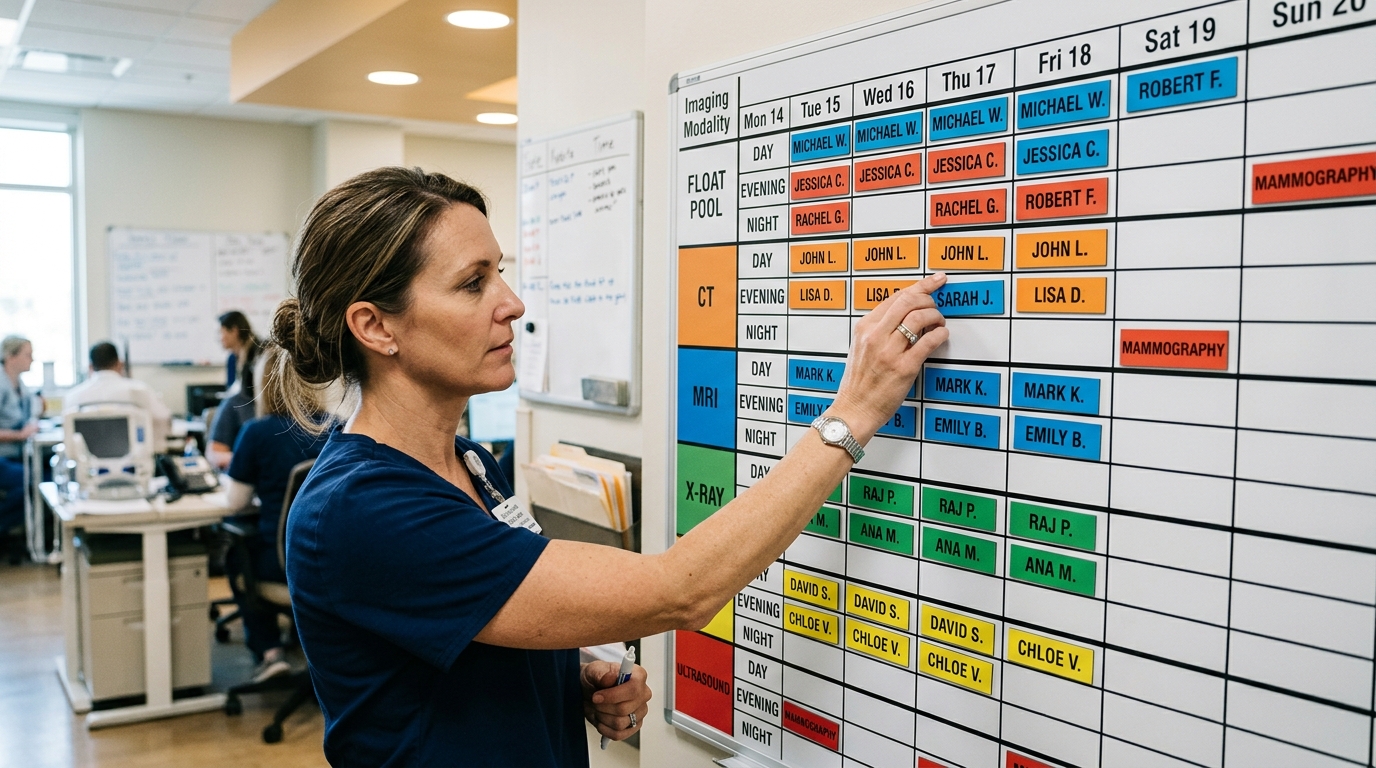
Quarterly Planning: Create quarterly assignments rather than weekly or monthly. This gives float pool staff predictability while allowing you flexibility.
"Next quarter, Sarah is assigned primarily to CT with backup to portable radiography. She works Tuesday-Thursday, guaranteed 24 hours, with Friday availability for surge coverage. When CT is slow, she covers portable exams."
Flexible Surge Coverage: During predictable high-volume periods (post-holidays, flu season), you can increase float pool hours or call in additional float pool members for temporary extra coverage.
Rotation Strategy: Decide if you want continuous rotation or longer assignments. I preferred 3-6 month assignments within specific areas rather than weekly rotation. This gave staff time to develop competency and relationships with their assigned departments.
Communication: Use a shared scheduling system that shows float pool members their assignments, allows them to request time off, and alerts them to surge needs. I used a simple spreadsheet initially, though larger systems might benefit from dedicated staffing software.
The Cost Analysis vs. Agency Staffing
Here's the concrete financial argument for float pools:
Agency Staffing Model (filling 10 hours weekly of variable demand):
- 10 hours weekly × $70/hour = $700/week
- 52 weeks annually = $36,400/year
- Plus: minimal consistency, training time needed, turnover costs
Float Pool Model (maintaining 1.5 FTE capacity):
- Base hours: 1.5 × 40 × $34/hour = $2,040/week
- Plus benefits (roughly 25% of salary) = $510/week
- Total: $2,550/week for guaranteed 60 hours
- 52 weeks = $132,600/year for consistent, trained staff
- Per-hour cost on the 60 hours: roughly $44/hour loaded
The Numbers: On the surface, this seems more expensive. But wait:
- The float pool covers your baseline variable demand (60-70 hours weekly) with trained, reliable staff
- You'll still use some agency for unpredicted surges, but far less
- Training costs drop significantly—your float pool already knows your systems
- Overtime drops—you've got built-in capacity
- Quality improves—fewer protocol deviations from agency staff not knowing your equipment
At my facility, we cut agency spending by nearly 40% while improving operational consistency. That float pool of 10 people more than paid for itself.
Common Pitfalls to Avoid
Pitfall 1: Treating float pool staff like second-class employees. They're not. They're core to your operations. Pay them fairly, include them in department events, and value their flexibility.
Pitfall 2: Over-rotating people too frequently. Some movement keeps things fresh, but constant rotation kills competency development and job satisfaction.
Pitfall 3: Not communicating scheduling clearly. Float pool staff need to know their schedules well in advance. Late schedule changes breed resentment fast.
Pitfall 4: Expecting floating without adequate training. Don't just move people into new areas without systematic training and competency verification.
Pitfall 5: Not defining what "float pool" means. Be explicit about hours, benefits, rotation expectations, and compensation. Vagueness causes problems.
The Reality
A properly built float pool isn't a cost center—it's an operational necessity. Healthcare staffing is unpredictable. You'll always have call-outs, unexpected volume changes, and seasonal fluctuations. Float pools let you manage that predictably and affordably.
When I left my position as department manager, the float pool I'd built over seven years was one of the strongest teams in the department. Retention was high. Quality was excellent. And we weren't bleeding money on agency staffing.
If you're not using some form of float pool model currently, I'd strongly encourage you to consider it. Start small—even 3-4 people on a trial basis. Build from there. Your operations (and your budget) will thank you.
Related Articles

Burned Out as a Rad Tech? Here's How to Reignite Your Career
April 23, 2026

Managing Up: How Rad Techs Can Influence Department Decisions
April 22, 2026

How to Compete With Travel Agency Pay Without Breaking Your Budget
April 22, 2026
Quality Assurance in Radiology: Why QA Culture Affects Retention
April 21, 2026